
AML and Source of Funds Compliance for UK Crypto Bettors
 Available in US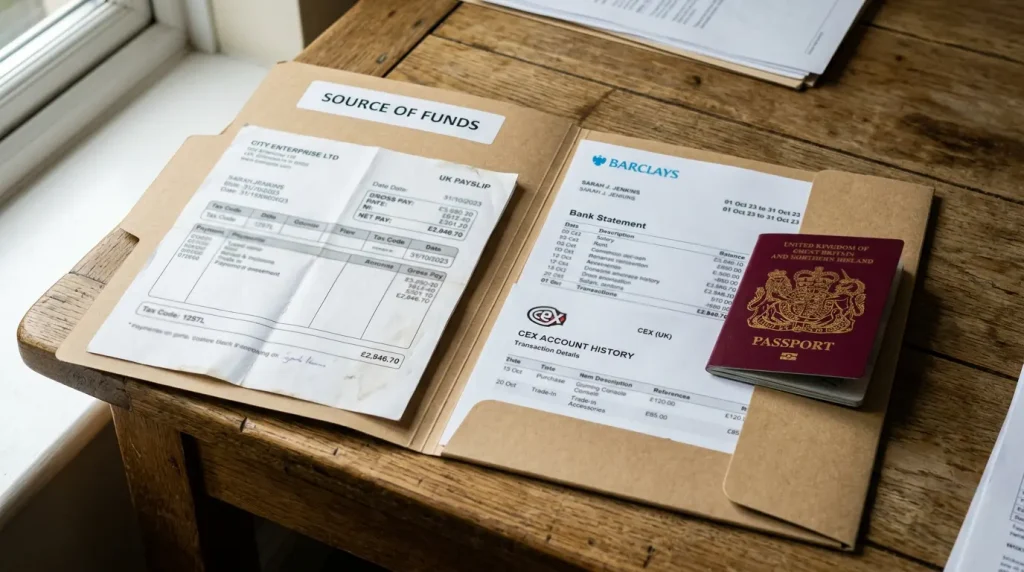
Preparing Documentation for Sportsbook Financial Checks
The phrase that took me a few seasons to internalise: an AML check is not designed to distinguish honest bettors from money launderers. It is designed to flag transactions that share statistical features with money laundering, and to require those flagged transactions to clear a documentation hurdle. A clean, honest bettor whose recent withdrawal looks like a structurally suspicious pattern will be flagged. A genuinely sophisticated launderer who has gone to the trouble of laundering the upstream layer will sometimes not be flagged. The system is rule-based, not intent-based, which means most of the friction lands on legitimate users.
The specific UK context matters. The senior leadership of the UK Gambling Commission has been warning publicly that the growth in crypto adoption among younger bettors is creating regulatory pressure, framing it as a challenge that did not really exist a few years ago and is now building inside the system at the level of demographic shift. That framing is not abstract. It translates into operators tightening their AML triggers, exchanges tightening their inflow checks, and the average bettor encountering more documentation requests in 2026 than they would have in 2022. This piece explains what the framework requires, what triggers checks in practice, and how to organise your upstream so the request, when it arrives, is a fifteen-minute exercise.
The framework that operators are working under
UK money laundering regulations apply to a range of regulated entities – banks, exchanges, and certain categories of professional service providers. Crypto sportsbooks based offshore are not directly regulated by UK MLRs in the way a UK bank is, but the operators voluntarily run AML programmes for two reasons. First, their licensing jurisdictions almost always require it as a condition of operating. Second, their banking and payments infrastructure relies on counterparties – payment processors, banks, exchange partners – who need to see a credible AML programme upstream from them.
The Travel Rule, derived from FATF guidance, is the international standard that requires regulated entities to share originator and beneficiary information when crypto value above a threshold moves between regulated counterparties. The threshold for the Travel Rule in the UK has been one thousand pounds since 2023. The practical effect for a bettor is that any withdrawal above that threshold from a regulated UK exchange to or from a sportsbook attracts originator-information requirements at the exchange end. The sportsbook may or may not satisfy those requirements directly; the exchange may impose additional checks if it cannot identify the counterparty.
Enhanced due diligence is a separate concept layered on top. EDD applies when a transaction or counterparty triggers higher-risk indicators – politically exposed persons, sanctioned jurisdictions, high-risk wallet histories. Sportsbook AML policies typically apply EDD-style requirements at withdrawal thresholds significantly below the formal regulatory definition, because the operator is making its own commercial judgement about risk appetite rather than just complying with the floor.
The triggers, in order of how often they fire
Withdrawal size is the first and largest. A clean account routing a small withdrawal through a known wallet pair clears automatically; a withdrawal above the operator’s internal threshold queues for review. The threshold varies by operator – common ranges sit between two and ten thousand dollars equivalent – and is usually a moving target tuned to the operator’s overall risk appetite at that moment.
Frequency is the second. A clean account routing the same withdrawal pattern monthly is normal. A pattern of multiple withdrawals just below threshold within a short window is the structuring signature, and operators monitor for it explicitly. The Chinese-language money laundering networks that have been the subject of extensive Chainalysis reporting moved sixteen point one billion dollars across 2025 – about forty-four million dollars per day – and a documented part of their methodology has been fragmenting transactions to evade detection. Sportsbooks know the pattern and the rule-based system fires on it regardless of whether the underlying behaviour is genuinely suspicious or coincidentally similar.
Wallet history is the third. On-chain analytics tools attach risk scores to every wallet based on its recent and historical interactions. A wallet that has touched a sanctioned address, a known mixer, or an exchange in a sanctioned jurisdiction picks up a risk score that flags it on inflow at the sportsbook side. The chain of inheritance is faster than most users realise – a wallet that received funds from a flagged source two transactions ago can pick up the inheritance, and the operator’s system reads the inheritance regardless of whether the bettor was the originator.
Sixty-three per cent of all illegal cryptocurrency transactions in 2024 were in stablecoins, and that headline statistic is the explanation for why stablecoin withdrawals at sportsbooks attract more friction per dollar than the equivalent BTC withdrawals. The model is not anti-stablecoin in principle; it is responding to where the empirical risk concentrates.
The fourth trigger is geography mismatch. An account whose declared residency is the United Kingdom, accessed routinely from a UK IP, funded from a UK CEX, and withdrawing to a UK CEX, looks consistent. The same account accessed from a non-UK IP for a substantial session, or funded from a wallet whose history points to a non-UK CEX, looks inconsistent. Inconsistency is not in itself proof of anything, but it is a flag.
The documentation that makes the request trivial
The standard request set, in order of likelihood: a current photo identification document, typically passport or driving licence; proof of address from within the last three months, typically a utility bill, bank statement or council tax letter; a CEX transaction history showing the buy of the relevant crypto in GBP; a bank statement showing the GBP outflow that funded the CEX purchase; for higher-value reviews, a payslip or other evidence of the income that funds the activity.
The practical setup is to have these documents pre-organised in a folder on a device you can reach quickly, refreshed every few months. Passport scan, current driving licence, current utility bill, recent bank statements, downloaded CEX history. When the request arrives by email, the response should be assembling the documents into a single ZIP and uploading. The total elapsed time should be under thirty minutes. The cases where verification becomes a multi-week exercise are almost always cases where the bettor was scrambling to assemble documentation that did not previously exist in coherent form.
One specific operational note for UK bettors. The CEX transaction history needs to show the buy-and-transfer flow that funded the sportsbook deposit. Coinbase, Kraken and the other UK-supporting exchanges all provide downloadable CSV reports for this purpose. The CSV should be a complete export, not a screenshot, because the operator will sometimes want to verify dates and counterparty addresses against the on-chain record.
The flow that minimises friction
Three habits dramatically reduce the chance of a long verification hold. Deposit and withdraw through the same UK CEX wallet address, so the on-chain history of the addresses involved in your sportsbook activity is consistent and easy to evidence. Avoid mixers, peer-to-peer counterparties whose wallets have unknown history, and exchanges that have been flagged for AML weaknesses. Keep a transaction log – date, sportsbook, deposit address, amount, txid – alongside the document folder, so any specific deposit can be reconstructed from your own records without depending on the operator’s record.
The tradeoff with this approach is privacy. A bettor who routes everything through the same UK CEX wallet creates a transaction graph that links sportsbook activity to a specific identity. For most UK bettors, that is fine – the activity is legal, the income is taxed correctly, and the friction-minimisation benefit outweighs the privacy cost. For a bettor whose privacy concerns are stronger, the alternative is to use multiple wallets at the cost of more complex documentation, accepting that the more complex history will sometimes mean longer reviews.
What to do if a hold lands
The short answer is: respond promptly with complete documentation through the operator’s stated channel and wait. Most holds resolve within days when the documentation is complete; the cases that drag for weeks are almost always either incomplete documentation, a wallet history that the operator’s analytics flagged, or a withdrawal at the upper limit of the operator’s risk tolerance.
If a hold extends beyond the operator’s stated review period without resolution, the escalation path is the operator’s complaints channel, then any third-party dispute resolution they have signed up to, then public dispute on the established sportsbook forums. Legal escalation in the strict sense is generally not a productive path for an offshore book; the leverage is reputational rather than juridical.
AML and KYC sit on opposite sides of the same problem – operators apply both, sometimes interchangeably. My piece on “no-KYC” crypto baseball sportsbooks and the UK reality covers the verification side specifically and how the marketing claim breaks down at the moment of withdrawal.
Articles




Prepared by the BlockPlate editorial staff.
