
MLB odds in fractional, decimal and American
 Available in US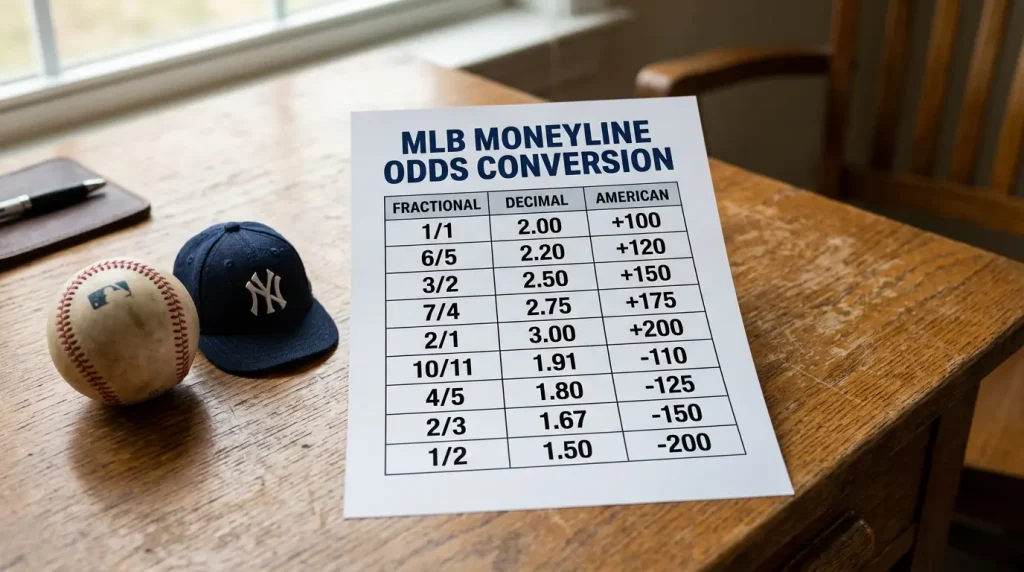
The same number, three different costumes
I grew up reading betting odds the British way: 5/2, 11/4, 6/4, 13/8. The fractions have a rhythm to them once you have read enough. The first decimal-format coupon I ever encountered – a continental European football slip – felt like a different language, and the first American moneyline I tried to interpret on a US sportsbook took me three minutes longer than it should have. They are all the same information about the same bet. The notations differ, the operator’s geography drives which one is on the screen by default, and a UK bettor on a global crypto sportsbook ends up looking at all three depending on the operator and the day.
This piece is a clean conversion guide. There are no pictures and no calculators built in; the maths is simple enough to do in your head once you understand it, and converting between formats is something you should be able to do quickly enough that the price never sits on the screen unread because you are still figuring out what it says. With an MLB regular season producing 2,430 fixtures across six months, and crypto operators now covering more than forty sports each, the ability to read odds in any of the three formats without translation is a small piece of the toolkit that adds up over time.
Three formats, one bet
Fractional odds – the British format – express the ratio of profit to stake. Five-to-two means risk two units, win five units of profit if successful, total return six units (the original two plus the five profit). The numerator is your profit, the denominator is your stake. Six-to-four means risk four to win six, total return ten. Eleven-to-eight means risk eight to win eleven, total return nineteen. The format is intuitive once you read enough of them but requires mental arithmetic for any non-trivial conversion.
Decimal odds – the European format – express the total return on a one-unit stake including the stake itself. A decimal price of 3.50 means a one-unit stake returns three and a half units in total, which is two and a half units of profit. A decimal price of 1.75 returns one and three-quarter units total, which is three-quarters of a unit of profit. The format is the easiest of the three for arithmetic because the implied probability is just one divided by the decimal price.
American odds – the US format – express two different things depending on whether the price is positive or negative. A negative number is the stake required to win one hundred units of profit; minus-150 means risk one hundred and fifty to win one hundred. A positive number is the profit on a one hundred unit stake; plus-150 means risk one hundred to win one hundred and fifty. The format is the least intuitive of the three because the unit of measurement flips at evens, but it is the dominant format on US-facing sportsbooks and on most of the crypto operators that cater primarily to North American bettors.
The conversion maths, in your head
Fractional to decimal: divide the numerator by the denominator and add one. Five-to-two becomes 2.5 plus 1, equals 3.50. Eleven-to-eight becomes 1.375 plus 1, equals 2.375. Six-to-four becomes 1.5 plus 1, equals 2.50. The plus-one converts the profit-only fractional figure to the total-return decimal figure.
Decimal to fractional: subtract one and express the result as a simple fraction. 3.50 becomes 2.50, which is five over two, written 5/2. 1.75 becomes 0.75, which is three over four, written 3/4 – though for any UK book this would actually be displayed as 3/4 alongside the more conventional 4/6 if the price were on the favourite side, depending on whether the bettor is placing on a horse or a sport.
Decimal to American is two cases. If the decimal is at or above 2.0, subtract one and multiply by one hundred to get the positive American figure. 2.50 becomes 1.50 times 100, equals plus-150. 3.50 becomes 2.50 times 100, equals plus-250. If the decimal is below 2.0, the American figure is negative. Compute one hundred divided by the decimal minus one, then negate. 1.75 becomes 100 divided by 0.75, equals 133.33, so minus-133. 1.50 becomes 100 divided by 0.5, equals 200, so minus-200.
American to decimal is the inverse of the above. Positive American: divide by one hundred and add one. Plus-150 becomes 1.50 plus 1, equals 2.50. Negative American: divide one hundred by the absolute value, then add one. Minus-150 becomes 100 divided by 150, equals 0.667, plus 1, equals 1.667.
The implied probability calculation simplifies dramatically with decimal. Implied probability is simply one divided by the decimal price. A decimal of 2.50 implies a probability of 0.40, or forty per cent. A decimal of 1.50 implies a probability of 0.667, or sixty-seven per cent. The same calculation in fractional or American requires more steps. The decimal-format ease is one reason most modelling and most analytical writing on betting uses decimal even when the headline display is fractional or American.
Why crypto books default to decimal
The vast majority of crypto sportsbooks display decimal odds by default because the operator is global rather than domestic. A book that takes wagers from European, Latin American, Asian and North American bettors picks the format that minimises friction for the largest segment of its audience, and decimal is the default in continental Europe, much of Latin America, and most of the developed Asian market. American is the default for the small subset of crypto operators that focus principally on North America.
Most crypto operators offer a settings toggle in the user account that switches the display to fractional or American. The toggle is sometimes buried – under preferences, under display, under format – but it does exist on the larger operators. For a UK bettor who finds decimal easier than fractional after a couple of weeks of using it, leaving the default is the simplest choice. For a UK bettor who wants fractional, the toggle is worth finding once and using forever.
One small operational note. Crypto operators with global trading desks sometimes display decimal odds with three decimal places where a US-facing book would round to whole American numbers. The extra precision is genuinely meaningful. A decimal price of 1.913 versus 1.917 is a real difference in expected value, and the ability to compare these without rounding to the nearest American whole number is one of the small advantages of decimal display.
Stay in one format when you compare lines
The most common mistake I see in newer bettors is comparing prices across two operators in different formats. The same moneyline at minus-180 on one operator and 1.55 decimal on another is roughly the same bet – minus-180 is decimal 1.556 – but the visual gap between the numbers is larger than the actual price gap. The bettor sees minus-180 next to 1.55 and is unsure which is the better price.
The fix is to convert everything into one format before comparing. If you mostly use decimal, set the operators that allow it to decimal. For the operator that is American-only, do the conversion in your head before reading. The discipline of converting once before comparing is an order of magnitude faster than converting back and forth across the comparison.
The same principle applies to comparing the operator’s price to your own model output. Run the model in decimal. Read the line in decimal. The implied probability comparison is one calculation rather than three.
The format question is closely tied to how you read the operator’s hold – the implied probability calculation that the format conversion enables is exactly what you need to extract the hold figure – and that maths is laid out in my piece on sportsbook hold and vig on MLB markets.
Articles



Published by the BlockPlate team.
