
Crypto Baseball Betting in the UK
 Available in US
Three regulators, one bet, no shortcuts.

Bitcoin Deposits & MLB Betting Markets for UK Punters
The first time I tried to back a Yankees moneyline with Bitcoin, I was sitting in a flat in Hackney watching the line drift in the seventh inning. The deposit cleared in eleven minutes. The bet settled three hours later. The withdrawal — a clean, profitable USDT withdrawal — sat in "pending review" for the better part of a working day. That morning taught me more about this niche than any of the affiliate-shaped guides I had read the week before. The mechanics are easy. The hard part is everything that surrounds them.
This article is specifically about what happens when you stack three things: you, sitting in the United Kingdom; cryptocurrency as your payment rail; and Major League Baseball as your sport. That stack lives inside three separate regulatory worlds — the Gambling Commission, the Financial Conduct Authority and HMRC — and each treats one of those three ingredients as their own. None treat all three together.
The blunt fact most reviews skip: no UKGC-licensed sportsbook accepts cryptocurrency. That is not a glitch and it is not temporary. It is the regulator's stated position, restated by the Commission's chief executive in late 2025. The route runs through offshore sites — and that fact reshapes everything downstream: KYC, withdrawals, tax, banking, even which coin you should use during the postseason.
Crypto adoption in the UK is a smaller, younger, more London-skewed slice than the headlines suggest. Roughly 8% of adults — about 4.5 million people — held a cryptoasset in the FCA's most recent research, and that proportion roughly doubles in the 18 to 34 cohort. That is your real addressable audience for crypto baseball betting in Britain.
What follows is a working map: what the three regulators actually require, why MLB has become a serious British product in two seasons, how the deposit and settlement plumbing really works, which markets reward attention, which coins behave themselves, and where the trapdoors are around bonuses, withdrawals, tax and source-of-funds checks.
The short version, before you place a wager
- UKGC-licensed sportsbooks do not accept cryptocurrency. Crypto baseball betting from Britain runs through offshore operators, with everything that implies for KYC, banking and recourse.
- The wager itself is tax-free. Every crypto disposal around it — swaps, deposits, withdrawals — is a Capital Gains Tax event, and CARF reporting from 2026 widens what HMRC sees.
- Moneyline, run line at plus or minus 1.5 and totals will get you started. F5, NRFI, YRFI and home run props are where MLB-specialised crypto books separate themselves.
- Remote Gaming Duty rises from 21% to 40% on 1 April 2026, with a separate 25% Remote Betting Rate from 2027. Up to 90% lands on the customer through worse prices.
- The audience is overwhelmingly 18 to 34 and disproportionately London. That is who this market is being built for.
Three regulators, three rulebooks, one bet
There is no such thing as a UK crypto gambling licence. There is no department where one applies for it, no checklist a sportsbook can complete to get it, and no public roadmap for one appearing within a betting career-relevant timeframe. Every conversation about crypto MLB betting from Britain starts in that vacuum.
Three regulators sit on this transaction at different points. The Gambling Commission supervises the sportsbook side. The Financial Conduct Authority supervises the cryptoasset side. HMRC sees the player. None have a unified view of what you are actually doing.
The Gambling Commission line is the cleanest. A UKGC licence requires a fiat-rails banking and AML stack. None of that maps cleanly onto a cryptocurrency rail, and the Commission has not opened a route for operators to bridge the gap. UKGC chief executive Andrew Rhodes has been blunt about the speed of the underlying problem, calling it "an 18-months-to-two-years challenge" rather than the five-year horizon he might have used a few years earlier. He has been just as clear that the Commission cannot quietly turn the licensing tap on for crypto by itself; that is a government-level decision, and once the door opens it does not close.
For October 2024 to September 2025, the UKGC's illegal gambling team issued 806 cease-and-desist letters and disrupted 314 unregulated sites targeting UK audiences. The 2025 Budget added £26 million of UKGC funding over three years to push that work harder. The offshore sites you can find today are a moving target by design.
The FCA line is newer and more technical. The Financial Services and Markets Act Cryptoassets Regulations passed on 4 February 2026, with the regime expected to take effect on 25 October 2027. That regime captures activities around the bet — exchanges, custodians, stablecoin issuers, certain wallet services — without making the sportsbook itself an FCA-regulated firm. The bridge you use to convert pounds into Bitcoin will eventually sit inside a UK regulatory perimeter. The bookmaker on the receiving end will not.
The HMRC line trips up almost everyone. A British individual's gambling winnings are not taxed. The part most reviews miss: every conversion of GBP into a cryptoasset, every send from your wallet to the sportsbook's hot wallet, and every withdrawal back to a wallet you control is a disposal under Capital Gains Tax rules. The bet result is tax-free; the crypto motion around it is not. CARF reporting, which HMRC is operationalising for cryptoasset service providers, will quietly close the gap on what the Revenue can see from 2026 onwards.
4 February 2026
FSMA Cryptoassets Regulations passed.
1 April 2026
Remote Gaming Duty rises from 21% to 40%.
1 April 2027
New Remote Betting Rate of 25% takes effect within General Betting Duty.
25 October 2027
Cryptoasset regulatory regime expected to commence.
The pattern matters. Duty rises hit licensed UK operators first and hardest, compressing fiat sportsbook margins and changing how British prices look against offshore prices on the same MLB game. The cryptoasset rules arrive a year later, formalising the point at which your CEX is unambiguously a UK-supervised entity feeding HMRC. Sitting in between is roughly eighteen months in which the offshore crypto sportsbook market is, in Rhodes's framing, a known headache for which there is no licensing answer.
Who is actually placing these bets from Britain
The image of a "UK crypto bettor" most operators carry around is usually wrong. It is not a generic punter swapping in their Bitcoin out of curiosity. It is a narrower, sharper profile.
Around 8% of UK adults — roughly 4.5 million people — owned a cryptoasset in the FCA's 2025 consumer research, half what it was in 2024 but still about double the 2021 baseline. Ownership in the 18 to 34 group runs at 15%, the highest of any cohort, and 73% of British holders acquired their crypto through centralised exchanges like Coinbase, Binance and Kraken rather than peer-to-peer or on-chain swaps. That last detail matters because every CEX-bought coin is traceable from purchase to disposal.
Inside the subset of British online gamblers who say they are interested in betting with crypto, 54% are aged 18 to 34 against 37% in the broader online gambling population. 72% are male against 63%. 29% live in London against 15% nationally. 31% of British crypto buyers in one recent study cited gambling itself as a reason they bought crypto in the first place.
That last figure should sit with you for a moment. For nearly a third of one cohort, the wallet and the wager are part of the same intent. Operators are not building generic sportsbooks. They are building products tuned for a London-skewed, male-skewed, twenties-and-thirties cohort who arrived through Binance and Coinbase.
Why baseball in Britain is no longer a curiosity
I queued for a London Series ticket in the summer of 2024 and was startled by who was around me. Not the American expats and Saturday tourists I had been expecting. A lot of British twenty-somethings in Yankees and Mets caps, talking pitch counts and bullpen depth in unmistakeable London accents. That was the moment baseball stopped being an export and became something the UK was building its own audience for.
The data has caught up with the queue. The Mets-Phillies London Series in 2024 pulled 108,956 spectators across two games, with around 71% of the crowd coming from Britain rather than abroad. MLB's UK social channels grew 133% across 2023 to 2024. UK merchandise sales rose 43% year on year. International MLB.TV minutes hit 14.5 billion in 2024, with international viewership up 18%.

Regular-season attendance across the 2025 MLB season totalled 71.4 million, the third year of growth and the longest streak since 2007. Average game time stayed below 2:40 for three seasons running. MLB and MLB Español social channels delivered 17.8 billion video views across the regular season, up 20% on 2024.
None of this is accidental. Chris Marinak, MLB's chief operations and strategy officer, has described the United Kingdom as "a priority market" the league plans to emphasise. The London Series is a deliberate fixture, with dates booked through the rest of the decade, designed to drag a young British audience into the regular-season rhythm. The betting consequence often gets missed: a thicker pipe of British eyeballs on MLB games means deeper liquidity, tighter prices and faster line updates at the books that take this seriously.
The takeaway is not that "baseball is hot in Britain". It is that the population of UK-based bettors who follow MLB closely enough to find an edge has roughly doubled in two seasons, and the gap between casual and informed money on these markets is wider than it is on football.
Pitch clock has a quiet role here. Faster games make live betting more usable: the gap between a meaningful event and the next price update is short enough to act on what you watched. A pre-clock 3:15 game punished the live bettor; a 2:38 average closes that window.
The plumbing, end to end, the way it actually behaves
Most "how does crypto sports betting work" explanations end at the point where you have a balance and a bet. That is the easy part. What punishes new users is the friction at the edges — before the deposit clears and after the bet settles. The sequence the way I actually run it now:
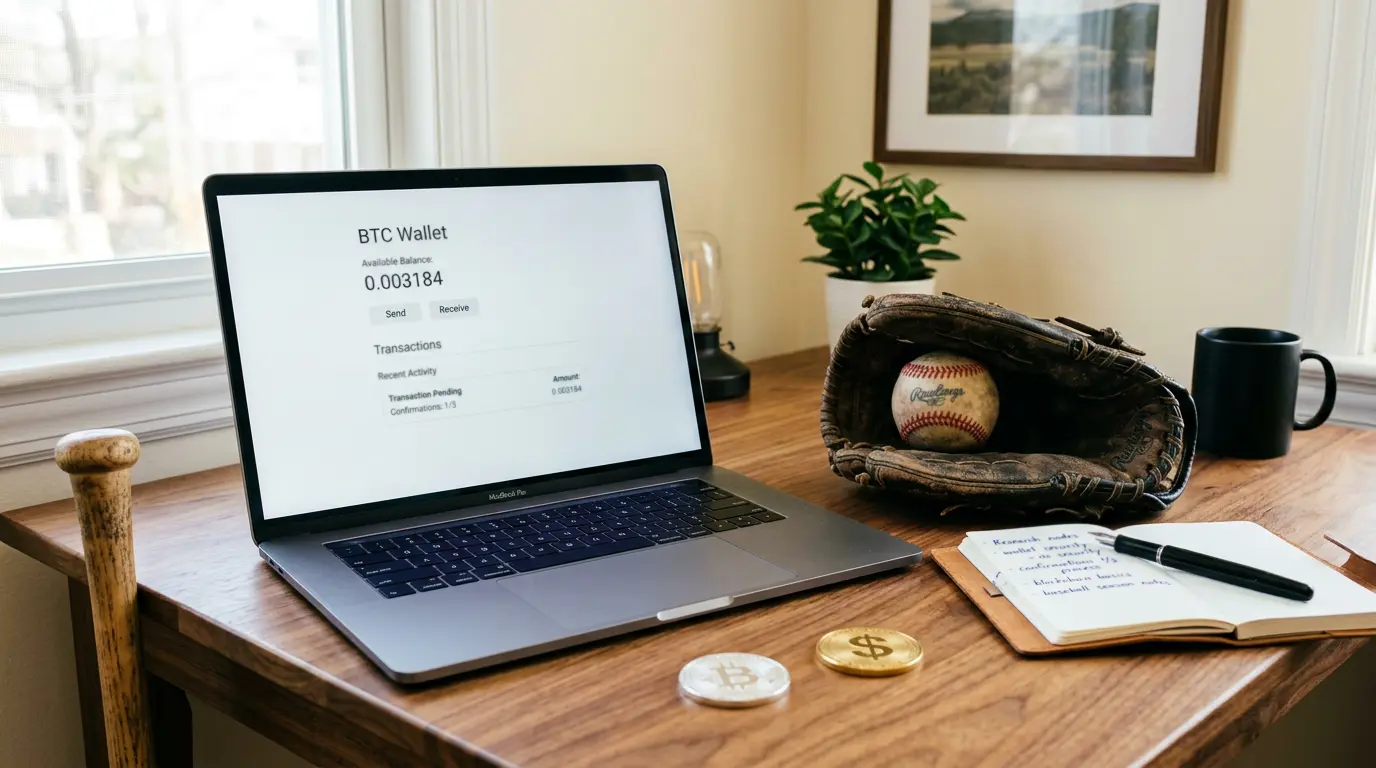
- Buy the coin on a UK CEX you already know. Coinbase, Binance, Kraken — pick the one your bank does not get nervous about. Buy in the amount you intend to bet, plus a small buffer for network fees. Do not route from a fresh wallet through a mixer. Your bank's outbound flow is being scored, and that pattern lights up like a Christmas tree.
- Send to the sportsbook deposit address. Every send is a CGT disposal in HMRC's eyes, even though no profit has been realised on the bet. Cost basis is the GBP value when you bought; disposal value is the GBP value when you sent.
- Wait for confirmations. A standard Bitcoin send needs one to three confirmations on most books — ten to forty minutes. Lightning is sub-minute. USDT on Tron settles in two to five minutes for cents in fees. USDT on Ethereum is slower and more expensive at peak times.
- Place the wager. The book usually quotes the line in fiat — dollars at most operators, sometimes pounds — and converts your crypto balance at the spot rate at bet placement. That conversion price is yours: the book locks it in.
- Watch the game. If the operator holds your remaining balance in Bitcoin and the price moves 7% during a Yankees vs Red Sox extra-innings affair, the GBP value of that balance moves with it. This is where stablecoins quietly earn their keep.
- Settle and withdraw. "Instant withdrawal" in marketing copy means the book broadcasts the on-chain transaction quickly once an internal review clears. The internal review is the slow part. On a fresh account or a large win, it will involve a source-of-funds question, even on books that advertise no-KYC at deposit.
The single most useful mental model: the on-chain step is fast and final, the off-chain step is slow and discretionary. The book controls one and the blockchain controls the other. Treat them as two completely different processes.
One subtlety that catches out newcomers is the difference between balance currency and bet denomination. A book that lets you deposit Bitcoin will often ledger your balance in Bitcoin, then settle bets at the BTC/USD rate at settlement time. If you placed a bet at 1.85 against a $60,000 BTC, and it wins six hours later when BTC is at $58,500, your USD payout is intact but your BTC balance has fewer coins. The opposite is true on the way down. Currency exposure layered on betting exposure compounds.
The Lightning rail genuinely changes the experience. When a sportsbook supports Lightning natively, both deposits and withdrawals stop feeling like sends and start feeling like card transactions. You give up some flexibility on amount, but the game-day cycle of "watch a price drift, click, get on" becomes possible in a way standard L1 simply does not allow.
The eight things I check before I trust a book with a bankroll
Most affiliate-shaped reviews are sorted by welcome bonus and house creative writing. Mine are not. I do not care about the welcome bonus until I have seen how the book holds up at the trade deadline, when half the lineup is changing, lines are being suspended, and the ones that stay open are pricing at 8% hold instead of the 4% they advertised in March. That is the only meaningful test of an MLB-capable book.
Eight criteria, in the order I would actually use them, weighted toward MLB.
| Criterion | What to test | Why it matters for MLB |
|---|---|---|
| Market depth on a single game | Count distinct markets on a midweek regular-season game | Run line, F5, NRFI, YRFI, totals, alt totals, player props, race-to-X must all be there |
| Live in-play coverage | Watch one game live; count seconds between event and price update | Pitch clock has compressed the meaningful-event interval; slow books are unusable in-play |
| Maximum stake limits | Push a hypothetical stake on a Yankees moneyline until you hit the cap | Tells you the real liquidity of the book versus the marketing claim |
| On-chain settlement support | Which networks: BTC L1, Lightning, Tron USDT, ERC-20, Solana, BSC? | Network choice drives speed, fees and your CGT cost-basis tracking burden |
| KYC trigger points | Read the terms for the threshold that flips KYC from optional to required | "No-KYC" books still trigger checks above defined withdrawal sizes |
| Bonus wagering structure | Headline percentage matters less than turnover multiple and minimum-odds rule | 5x at 1.5+ is workable for MLB; 40x at 1.8+ is a marketing trap on baseball pricing |
| Dispute resolution track record | Search forum threads for the operator name plus "withdrawal" | The signal-to-noise on user complaints is the best predictor of how a problem gets handled |
| UK accessibility without VPN | Register from a British IP and try a small deposit-withdrawal cycle | If the round-trip works without theatre, the book is genuinely UK-accessible |
"Low fees and a big bonus" are not in that list. They are downstream of everything else. A site that nails the first three but charges a flat fee on Lightning is still a better book than a site with zero fees and a market depth of "moneyline, run line and over/under". Liquidity is where edges live, and liquidity is where shallow operators bleed users.
For raw scale, a few public numbers help. Stake.com processes around $1.1 billion in monthly deposits on the casino side and holds roughly 52% share among the largest crypto casinos — though casino volume is not sportsbook volume. Cloudbet's reported 2026 figures showed roughly a doubling in basketball wagering volume year on year, with tennis up 50% and football up 30%; the platform now lists 40-plus sports.
The bonus is a marketing layer. Liquidity, market depth and dispute history are the operating layer. Spend ten minutes testing the operating layer and the marketing layer becomes irrelevant.
I have written a longer review of how to score a crypto baseball book against these criteria, with practical worked tests, in the cluster on the best crypto baseball betting sites for UK players.
BTC, USDT and the four others worth knowing about
My first crypto baseball season I held the entire bankroll in Bitcoin and finished August up on bets but down in pound terms because BTC had wandered south for six weeks. The choice of coin is the second-largest decision on any wager, behind only the bet itself. Six coins matter for an MLB-betting British user, each for different reasons.

| Coin | Strength | Weakness | Best for |
|---|---|---|---|
| BTC (L1) | Universal acceptance, deepest liquidity, highest off-ramp options | Volatility while bet is open; 10–60 minute confirmations | Long bankroll, planned deposits, futures bets |
| BTC (Lightning) | Sub-minute deposits and withdrawals, very low fees | Limited operator support; works best for small to medium amounts | Live in-play, single-game cycles |
| USDT (Tron) | Stable in GBP terms, 2–5 minute settlement, minimal fees | Higher AML scrutiny on large withdrawals | Working bankroll, regular weekly action |
| USDC (Ethereum or Solana) | Issuer-backed reserves, transparent attestations, US dollar parity | Less universal than USDT among crypto sportsbooks | Bettors who prioritise stablecoin counterparty quality |
| ETH | Wide acceptance, sits on the same network as USDC | Volatile in GBP, gas fees on busy chains | Punters already holding ETH for non-betting reasons |
| LTC, TRX | Low-fee, fast networks; widely accepted | Smaller GBP off-ramps; some thinner liquidity | Topping up small balances, fast in-and-out cycles |
The framework is simpler than the table looks. Bitcoin gives you upside; stablecoins give you accounting peace. If BTC drifts higher across the season, holding the bankroll in BTC means a winning bet pays you twice. If the next move is sideways or down, the same balance is a hidden short on yourself. Stablecoins remove the question. I hold the bankroll in USDT during the season and consolidate profits into BTC at month-end — personal preference, not a recommendation.
Bitcoin accounted for roughly 77% of all crypto sportsbook volume in 2025, with the category processing around $14 billion across the year. What flows behind it matters more: stablecoins made up about 63% of all illicit cryptocurrency transactions in 2024, which is why books tighten their KYC and source-of-funds checks on large stablecoin withdrawals even when they wave deposits through.
That second statistic explains a lot of frustrated forum posts. A British user deposits 200 pounds in USDT, runs it up to a four-figure bankroll, asks to withdraw and gets a documentation request that feels disproportionate. The book is reading the same Chainalysis numbers everyone else does and calibrating review thresholds accordingly. Bitcoin withdrawals at the same size often get less friction — not because BTC is safer, but because stablecoin AML risk profiles drive different internal triggers.
Lightning deserves its own line. It is the only payment rail that closes the gap between a fast-moving live MLB line and a trader who needs to top up. If a book supports Lightning, that is the option to use for any in-game decision. If not, you live with L1 confirmations and plan around them.
If you want a deeper comparison of coin-by-coin behaviour for MLB bankroll management, including how stablecoin choice interacts with hold rate and how Lightning changes effective fees, the cluster on the best cryptocurrency for MLB betting goes into the detail there.
The MLB market menu, beyond the three you already know
Ask a casual British bettor how to bet on baseball and you will hear three answers: pick a winner, pick a total, maybe pick a handicap. That is the football mind speaking. A single MLB game on a serious crypto book opens with thirty to sixty distinct markets, and the interesting money lives well past the first three. If a book lists fewer than fifteen on a midweek game, you are looking at a casino with a baseball logo, not a sportsbook.
Here are the major market families, set up as a menu rather than a glossary.
| Market family | What you are betting | Why it exists in baseball specifically |
|---|---|---|
| Moneyline | Outright winner of the game, no handicap | The simplest baseball price; reflects the full quoted edge between two teams |
| Run line | Handicap, almost always at plus or minus 1.5 runs | Baseball's low scoring means a half-run handicap creates the spread that football already has at 0 |
| Totals (over or under) | Combined runs scored by both teams | Quote varies wildly by ballpark, weather and starting pitcher matchup |
| F5 (first five innings) | The scoreline at the end of the fifth inning | Removes bullpen variance; you are betting the starting pitcher matchup directly |
| NRFI / YRFI | Whether a run is scored in the first inning | A two-pitcher prop that is statistically richer than it looks |
| Player props | Hits, home runs, strikeouts, total bases by individual player | This is where MLB-specialised books outclass casino-style sportsbooks |
| Futures | World Series, division winners, MVP, Cy Young, season win totals | Long-hold positions; huge variance in how books price the same outcome |
| Live in-play | Shifting prices through the game on any of the above | Pitch clock changes have made this genuinely tradable from the UK |
The run line lives at exactly plus or minus 1.5 runs because baseball's average game produces too few runs for a wider handicap to be meaningful. Football comfortably hands out a 3.5-point spread; baseball would be priced into oblivion at the equivalent. The 1.5 figure reflects roughly half a typical run-scoring inning. "Alternative run lines" at 2.5 or 3.5 are decoration on top of the standard.
Player props deserve their own paragraph. The home run prop has become the single most active MLB market by volume on at least one major US book — FanDuel reported it as the most popular MLB market type in 2025, with roughly half its MLB customer base joining the firm's themed Tuesday promotion. That is a useful signal even though FanDuel is not a crypto book: it tells you where casual money has gone, which tells you how operators on every rail will price these markets going forward. Crypto books that take MLB seriously offer at-bat props, inning-specific runs, race-to-X-runs and pitcher prop builders combining strikeouts, walks and hits.
A crude but useful test: count the player prop options on the visiting team's batting order on a midweek game in May. If the book offers less than three different prop types per player on the starting nine, the MLB book is shallow. Serious operators will give you anywhere from five to ten per player.
One MLB-specific market British football bettors miss: the F5 — the first five innings — is essentially the starting pitcher's contest. Modern bullpen usage is volatile; a starter pulled at sixty pitches is now normal. Betting the F5 lets you take a pure pitching view without paying for relief uncertainty. NRFI ("no runs first inning") works the same way at higher granularity, and the prices are often softer than they should be early in the season because casual money does not engage with them.
Futures are where crypto books distinguish themselves favourably. Because operators can hold open positions for months without UKGC reporting weight, World Series, MVP and Cy Young futures often sit at fuller prices than fiat counterparts during spring and early summer. The flip side: an offshore book holding your Cy Young position from May through September is a counterparty risk you live with for four months.
The full deep dive on each market family — including practical worked examples of when run line, F5 and NRFI prices diverge from "fair" — sits in the cluster article on MLB betting markets explained for crypto bettors. This section is the menu; that one is the kitchen.
The instant withdrawal myth, and what bonuses actually cost you
"Instant withdrawal" is the most overused phrase in this category. The on-chain step is genuinely instant — finality in minutes for L1 Bitcoin, seconds for Lightning or Tron USDT. The off-chain step — the operator's internal review of your withdrawal request — is where time disappears.
The shape of a typical match bonus is a 100% deposit match capped between £50 and £1000 in crypto equivalent, with a wagering requirement from 5x at the friendly end up to 40x at the punitive end. Layered on that is a minimum-odds rule, usually 1.5 or higher. That second rule is where the bonus actually costs you on baseball: heavy moneyline favourites — your minus-200 Yankees over the Athletics on a midweek night in July — are excluded from contributing.
A 100% match on £200 with 35x wagering at minimum 1.8 odds is a £7,000 turnover requirement on prices that exclude precisely the kind of safe favourite you might have staked just to clear it. On most baseball cards, that is impossible to clear within the bonus expiry window without taking lines you would not normally take. The bonus that looks free is a forced bet sequence at adverse pricing.
The healthier shape is closer to a 25% to 50% match with 5x or 8x wagering at 1.5 minimum, sometimes with sport-specific contribution where MLB markets count at 50% rather than 100%. That maths can clear in a normal week of betting at lines you would have taken anyway.
Withdrawal speed is where the comparison with UK fiat operators becomes uncomfortable for crypto. The Gambling Commission's IAGR keynote disclosed that across 44.2 million withdrawal requests in June to September 2024, 96.3% were processed automatically, 3.5% within 24 hours, and only 0.1% took longer than 48 hours. That is the bar a UKGC-licensed PayPal withdrawal hits as standard. Offshore crypto books vary enormously around it. Some clear in fifteen minutes; others quote "up to 72 hours" and use the full window routinely.
The pattern across forum complaints is consistent: withdrawals under a few hundred pounds clear quickly almost everywhere. Four-figure withdrawals, especially right after a winning streak, trigger source-of-funds review at almost every operator, including those advertising no-KYC at deposit. The advertised speed is the floor case, not the typical case.
The practical adjustment: withdraw little and often rather than letting a bankroll build. Treating the operator wallet as a transaction account rather than a savings account avoids both the long-tail review delays and the counterparty risk of leaving meaningful balances on a site you cannot send a recorded letter to.
The full mechanics of crypto sportsbook deposits and withdrawals — including a structured walk-through of source-of-funds responses, fee comparisons across networks, and what to do when a withdrawal sits in pending review for longer than the operator's stated window — are covered in the cluster guide on crypto sportsbook deposits and withdrawals for baseball. That is where the operational detail lives.
The data on harm is uncomfortable; it should change how you set up
Most crypto sportsbook guides bury responsible gambling in a single line above the footer. The academic and regulator data on crypto and gambling-related harm is substantially worse than the equivalent fiat-betting data, and pretending otherwise is a disservice. The shape of the risk is structural, not moralistic. It changes how a sensible person should set the system up before they place a wager.
A 2025 meta-review in Public Health, building on earlier studies, showed that crypto traders score significantly higher on the Problem Gambling Severity Index than equity investors and non-investors. The mechanism is not mysterious. Crypto exposure normalises 24/7 price volatility, frequent rebalancing and outcome anchoring on short timeframes — all behaviours that translate directly into how a person engages with sports markets. If your weekday already includes opening Coinbase before bed to check overnight movement, you have rehearsed the muscle that makes uncontrolled in-play betting feel natural.
The Gambling Commission's pilot of financial risk assessments using credit-reference data found that high-spending players were 2 to 4 times more likely than the general gambling population to be on a debt management plan, and 2 to 5 times more likely to have defaulted on a credit obligation in the previous twelve months. That is a figure specifically about the upper tail by spend — the cohort most likely to gravitate toward higher-limit, faster-rail crypto books.
Chancellor Rachel Reeves, defending the duty package in the House of Commons, said: "online gaming, in particular, but also online betting result in more serious harms than in-person betting." That is the empirical premise underneath the 2026 RGD increase, and the premise that explains why the UK system is unwilling to wave crypto operators through the licensing door.
The responsible setup for a UK crypto baseball bettor is more aggressive than for a UK fiat baseball bettor. The deposit-to-loss conversion is faster, the rail is 24/7, the bankroll is denominated in a volatile asset, and the operator is offshore with weaker enforcement of self-exclusion than the UK ecosystem provides through GAMSTOP.
Three behaviours work disproportionately well here. First, denominate your working bankroll in a stablecoin and consolidate profits to a separate cold-storage wallet rather than letting them sit on the operator. The visual feedback of a stable balance removes the volatility-driven escalation that BTC-denominated balances produce. Second, set a fixed per-session cap and walk away when it is hit. Third, do not chase. The single most reliable indicator of a session moving from recreation to harm is doubling stake size after a loss. Crypto rails make that easier, not harder; treat that ease as a warning, not a feature.
If you are reading this section twice and recognising the patterns, the UK has GAMSTOP, GamCare, and the National Gambling Helpline on 0808 8020 133. None of those services are conditional on your operator being UK-licensed.
The tax bit is where most punters quietly mess up
"Gambling winnings are tax-free in the UK" is true. It is also incomplete in a way that costs careless British crypto bettors money every year. The bet outcome is not taxable. The crypto motion that wraps the bet — the buying, sending, returning, swapping — is taxable, and HMRC treats every one of those movements as a Capital Gains Tax disposal whether you realised any "profit" on the sport or not.
One bet generates four ledger entries: you bought BTC at a GBP price (acquisition basis), sent BTC to the sportsbook (disposal, with gain or loss against basis), received BTC back when the bet settled (fresh acquisition), then sent that BTC to a personal wallet or back to your CEX (second disposal). Four entries, two disposals, one bet — none erased by the bet itself being tax-free.
The annual exempt amount for CGT is the gain you can absorb before any tax is owed; everything above it is reportable on self-assessment. A year of regular crypto baseball betting can easily produce dozens of disposals on small amounts, and the cumulative gain across them — from market drift, not from bets — is what gets measured.
The AML side has tightened in parallel. Around 63% of all illicit cryptocurrency transactions in 2024 involved stablecoins, against $40 billion of total illicit volume that year. Chinese-language laundering networks alone processed about $16.1 billion in 2025, with gambling services frequently used as fragmentation layers. Crypto sportsbooks read those numbers and calibrate triggers against them. "No-KYC, ever" fails on contact with a real four-figure withdrawal. Source of funds will be requested. The only question is at what threshold.
A clean transaction history is the most valuable asset a UK crypto bettor can build. Every CEX export, every wallet send and every operator deposit confirmation should be saved. When a source-of-funds question arrives, the gap between "I can produce six months of clean records in an afternoon" and "I will reconstruct this from screenshots" is the gap between a one-week resolution and a permanently locked withdrawal.
One operational rule sits above the rest: do not run funds through a mixer or chain-hopping service before a sportsbook deposit. Even if origin coins are perfectly clean, the routing pattern itself is what risk-scoring engines flag. UK banks have grown more willing to freeze the originating GBP transfer when they see a CEX outbound to a recognisably-sportsbook address.
For a deeper treatment of the regulatory architecture — UKGC, FCA and HMRC layered together, including the FSMA cryptoasset regime and CARF — the cluster on UK crypto gambling regulation for baseball bettors is the dedicated guide.
The April 2026 duty changes and what they actually do to your prices
The fiscal piece will visibly change how MLB markets are priced from 1 April 2026. Remote Gaming Duty rises from 21% to 40% on that date. A separate Remote Betting Rate of 25% within General Betting Duty arrives from 1 April 2027. UK horseracing has been carved out at 15%, but everything else online sits inside the new structure. The package is forecast to bring the Treasury more than £1 billion a year.
Now
Remote Gaming Duty at 21%; Remote Betting at 15%
1 April 2026
Remote Gaming Duty rises to 40%
1 April 2027
Remote Betting Rate of 25% introduced
OBR analysis assumed up to 90% of those duty rises will be passed to consumers through worse prices, smaller bonuses and tighter limits. The British price you see on a Yankees moneyline at a UKGC operator is going to widen against the offshore crypto price on the same game. That is the structural reason offshore crypto books are about to become more competitive on price alone, before any bonus or rail differences are considered. The same Treasury package added £26 million of UKGC funding over three years specifically to prosecute the offshore market harder.
The seven steps from a UK current account to a settled bet
If you have read everything to this point, here is the operational picture compressed into a sequence. Seven steps, written for someone with a British bank account, no existing crypto wallet, no existing sportsbook account. Skip nothing on a first run.

- Open a CEX account that your bank tolerates. Coinbase, Kraken and Binance all have UK presences. Complete full ID and address verification at this stage; you do not want to be doing it later under time pressure. High-street challenger banks generally cope well with crypto outbound; a small number of legacy banks treat all of it as suspect.
- Buy a small test amount of the coin you intend to use. Twenty pounds in BTC or USDT is enough. Do not deposit the full bankroll. The point is to discover whether your bank approves the GBP transfer and whether your CEX approves the buy without an additional verification ask.
- Open the sportsbook account from a British IP without a VPN. Provide your real address. If the operator silently blocks UK registrations and you discover it now, you have lost nothing. If the interface flips into a different language or rejects the postcode format, treat that as a signal about their actual UK appetite.
- Send the test amount on-chain to the deposit address. Copy the address; do not type it. Use the network the operator specifies — sending USDT-Tron to an Ethereum address is the most expensive mistake in this category. Wait for confirmations and verify the deposit shows in your balance before sending anything larger.
- Place a small first bet. Pick a market you would have bet anyway — a midweek MLB moneyline or run line — at normal stake size. The point is to verify settlement works as advertised, not to chase the bonus. Bonuses can be claimed later; sequencing matters more than yield on the first cycle.
- Withdraw the unused balance. Before depositing anything serious, do a withdrawal back to a wallet you control. This is the single most important reality check on any new operator. If withdrawal works smoothly at small amounts, you have evidence the round trip works.
- Scale up only after a clean round trip. Once steps one through six complete without friction, the operator has earned the right to a meaningful bankroll. Even then, keep it within the limit you would set on a UKGC site. The offshore environment does not have GAMSTOP, IBAS, or a regulator you can call.
One UK-specific addition: some sportsbooks introduce an additional residency check at the first major withdrawal, asking for evidence of address. Have a recent utility bill or bank statement ready as a PDF, dated within three months. Producing that the moment it is requested can be the difference between a same-day withdrawal and a week-long impasse.
Questions British MLB punters ask me most often
Is it legal to bet on baseball with cryptocurrency from the UK?
Placing the bet from a British address is not criminalised on the player side. The legal weight sits on the operator side: a sportsbook taking crypto wagers from UK customers without a Gambling Commission licence is operating outside the licensed perimeter. The practical risks for the bettor are not criminal but operational — banking friction, source-of-funds checks, withdrawal disputes with no UK ombudsman, and the absence of GAMSTOP-style protections.
Which cryptocurrencies are accepted at baseball sportsbooks?
Bitcoin remains the dominant rail — it accounts for roughly 77% of all crypto sportsbook volume in 2025 — and almost every operator that takes crypto will take BTC. After that, the standard short list is Ethereum, USDT (on Tron and ERC-20), USDC, Litecoin, and increasingly Bitcoin over the Lightning Network. Smaller books may add Tron, Solana, BNB or DOGE. The practical question is rarely whether your coin is supported but which network the operator uses for it: a USDT deposit on Tron settles in seconds for cents, the same USDT on Ethereum can take several minutes and a noticeable gas fee.
How fast are crypto withdrawals from a baseball sportsbook?
Two clocks run in parallel and only the slower one matters. The first is on-chain confirmation: Lightning is sub-second, USDT on Tron is seconds, USDT on Ethereum or Bitcoin's main chain is typically a few minutes to half an hour. The second is the operator's internal review — manual sign-off on larger amounts, source-of-funds checks, bonus-clearing verification. A book may advertise "instant withdrawals" and still hold a five-figure cash-out for a day. For comparison, UK-licensed fiat operators reported in 2024 that 96.3% of withdrawal requests were processed automatically and only 0.1% took longer than 48 hours; offshore crypto books rarely publish equivalent figures.
Do UK-licensed sportsbooks accept Bitcoin for MLB bets?
No. A Gambling Commission remote betting licence requires the operator to handle wagers in fiat through regulated payment rails, and the Commission's public position is that crypto is incompatible with that perimeter. Every well-known UK-licensed book — bet365, William Hill, Sky Bet, Paddy Power, Ladbrokes — settles MLB markets in pounds via card, bank transfer, or e-wallet. Any sportsbook accepting Bitcoin for a baseball wager from a UK address is operating offshore. That changes a lot at once: no UKGC complaints route, no GAMSTOP enforcement, no FCA-regulated payment provider in the chain, and a different KYC posture on the way out.
What is the difference between moneyline and run line in baseball betting?
Moneyline is the straight pick: you back one team to win the game, with no run handicap, and the price is set so a heavy favourite pays small and an underdog pays big. Run line is a fixed handicap of ±1.5 runs — the favourite must win by at least two, the underdog can lose by exactly one and still cash. The 1.5-run hook is standard in baseball precisely because runs are scarce: roughly a third of MLB games end with a one-run margin, so handicapping by exactly that amount produces prices close to coin-flip territory rather than the heavy juice you see on a moneyline favourite.
Are crypto winnings from baseball bets taxable in the UK?
The wager itself is not taxed at the punter's level — UK gambling winnings have not attracted personal income or capital gains tax since 2001. The complication is that the sportsbook pays you in crypto, and HMRC treats crypto as property. The disposal that creates a CGT event is not the bet but everything that happens around it: buying the BTC at a CEX, sending it to the operator, swapping coins inside the operator's wallet, withdrawing back, and ultimately selling for fiat. Every one of those is a disposal at the GBP value on the day, with cost basis pooled under the S104 rule. From January 2026 the CARF reporting framework also feeds your CEX activity to HMRC automatically.
Should I bet with Bitcoin or a stablecoin on baseball?
For a single wager, the choice comes down to whether you want price exposure layered on top of the bet. Stake in USDT or USDC and your stake is a stable dollar amount; the only variable is the result of the game. Stake in Bitcoin and you are running two trades at once — the MLB outcome plus the BTC price between bet placement and settlement. A two-day series can swing 5% on the coin alone, which is more than the edge on most baseball lines. Stablecoins also make bankroll arithmetic cleaner if you are tracking ROI. The trade-off is that operators tend to apply firmer KYC scrutiny on larger USDT withdrawals than on equivalent BTC ones, because stablecoins dominate illicit flows in the latest FATF data.
Read also



Published by the BlockPlate team.
