
Crypto Sportsbook Baseball Accumulators in the UK
 Available in US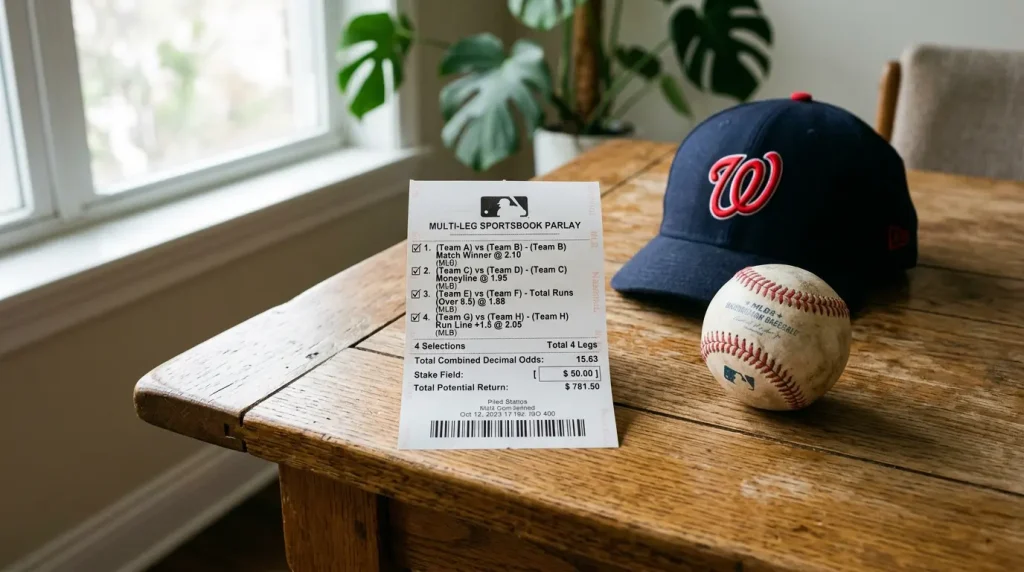
Structuring MLB Parlays and Accumulator Bonus Boosts
An accumulator – what the Americans call a parlay – is one ticket with multiple selections, all of which need to win for the ticket to cash, with the combined odds being the product of every leg. UK bettors grew up on accumulators in football. Five Premier League teams to win, four pounds in, twenty-something pounds back if everything held. The maths is intuitive once you have placed enough of them.
Accumulators on baseball are a different animal. Crypto sportsbooks promote acca bets aggressively because the maths runs in the operator’s favour: the longer the slip, the larger the cumulative hold, and the more likely the average punter is to lose the lot. With an MLB regular season producing 2,430 fixtures across six months, there is no shortage of legs to choose from on any given evening. That abundance is part of the trap. This piece is about how to think about acca bets on baseball – the maths, the same-game parlay version, the boost promotions, and the bankroll discipline that keeps the slip from becoming a slow leak.
The maths nobody runs before they hit confirm
If a single MLB moneyline at a sharp crypto book has a hold of around five per cent – a typical figure on a competitive market – then a three-leg accumulator built from three independent moneylines has a cumulative hold of approximately fifteen per cent. A five-leg acca pushes towards twenty-five. By the time you are at eight legs, you are betting into a hold north of forty per cent, which is worse than season-long futures and worse than most casino games. The effect is multiplicative because each independent leg has its own embedded margin, and stacking legs stacks the margin.
The sales pitch the operator runs is the headline payout. Eight legs at evens-ish prices – say decimal 1.91 each – produces a combined coefficient of around 235. Stake of a tenner returns two and a half grand if the slip lands. That is the carrot. The stick is that the implied probability of all eight legs landing simultaneously, even at the operator’s stated odds, is below half a per cent, and the actual probability after subtracting the embedded hold is meaningfully lower again. The expected return on a five-leg parlay of moneyline favourites at a typical crypto sportsbook hold is in the low seventies of pence per pound staked. That is not betting; that is buying a lottery ticket.
The reason to ever build an accumulator is therefore not the headline payout. It is to express a correlated view that the individual legs cannot capture cleanly, or to take advantage of a specific promotional structure. Both of those need careful handling.
Same-game parlays, where correlation is the entire game
A same-game parlay – SGP, in operator shorthand – is an accumulator where all the legs come from the same game. On baseball this is exactly the place where correlation has teeth. Take a starting pitcher’s strikeout total and the total runs over/under in the same game. If the pitcher dominates and posts strikeouts above his line, total runs are more likely to fall under the line because his outs are quick and the opposing offence is not scratching baserunners across. The two outcomes are positively correlated.
The sharper crypto sportsbooks recognise this and adjust the SGP price downward when the legs are correlated, so the combined coefficient does not simply multiply the individual prices. A naive multiplier – leg one decimal price times leg two decimal price – would give the punter a free option, because a positively-correlated outcome compounds in their favour. Operators that handle correlation properly cut the implied price; operators that handle it improperly leave the value on the table for whoever spots it.
The operators that get this most wrong tend to be smaller crypto books with thin trading desks. A naive correlation handling on an SGP at a small operator is one of the cleaner edges I have come across in the last three years of MLB wagering, but the catch is that small operators also have low limits on SGP tickets, often capping the maximum stake at a fraction of the equivalent moneyline limit. The edge exists; the size at which you can take it is constrained.
The other side of the same coin is when the operator handles correlation aggressively and the SGP price is worse than naive. Two legs that are negatively correlated – say, the home team to win moneyline plus a high-scoring over total – should be priced at a discount because the joint probability is lower than the multiplier would suggest. Operators sometimes fail to apply the discount, and you end up overpaying. Read every SGP price as a question: is this correlation handled the way I would handle it, or is it handled in a way that overpays the operator?
Boosts, promotions, and reading the small print
Many crypto sportsbooks offer accumulator boosts: a percentage uplift on the combined coefficient that scales with the number of legs. A typical structure might be five per cent boost on three-leg accas, ten per cent on four-leg, fifteen on five-leg, and so on up to a cap. The structure is positioned as a generosity – the operator is giving you back some of the stacked hold – but the conditions matter.
The most common conditions: each leg must be priced at or above a minimum decimal – typically 1.40 or 1.50 – so heavy moneyline favourites are excluded; same-game legs do not count toward the boost; certain markets like player props or futures are excluded; the boost applies only to the bonus portion of the win, not to the original stake; the boost does not stack with other promotions; and the boost is capped at a maximum payout regardless of how large the slip is.
The arithmetic effect of those conditions is that the headline boost percentage is rarely the actual boost percentage. A “ten per cent acca boost” subject to an exclusion of one of your four legs because it is below 1.40 may collapse to no boost at all, because the boost only kicks in at a four-leg minimum. A boost capped at five hundred dollars on a slip with a notional payout of three thousand is a much smaller percentage than the marketing implies. Read the conditions tab before you decide that the boost makes the acca worth placing.
Bankroll, with the variance turned up
An accumulator is the highest-variance bet shape on a sportsbook. The expected return is meaningfully negative on the average ticket, the actual return is bimodal – either nothing or a multiple – and the variance kills consistency. A bettor who sizes accas at the same unit as moneyline plays will be on a long, painful drawdown for entire stretches of a season.
I size accumulators at half a unit at most. Often a quarter. The principle is that an acca is a recreational, expressive bet – the bettor is paying for the entertainment of imagining the slip cashing – and the size of the stake should reflect that, not the size of a confident value play. The bettor who treats an acca as a value play is the bettor the operator’s bonus structure was designed for.
The maths of accumulator hold scales straight out of the maths of single-leg hold; for the underlying calculation and how to spot a fat-margin MLB market on a crypto book, see the breakdown in sportsbook hold and vig on MLB markets.
Articles




Created by the "BlockPlate" editorial team.
