
Lightning Network Payouts for Baseball Sportsbooks
 Available in US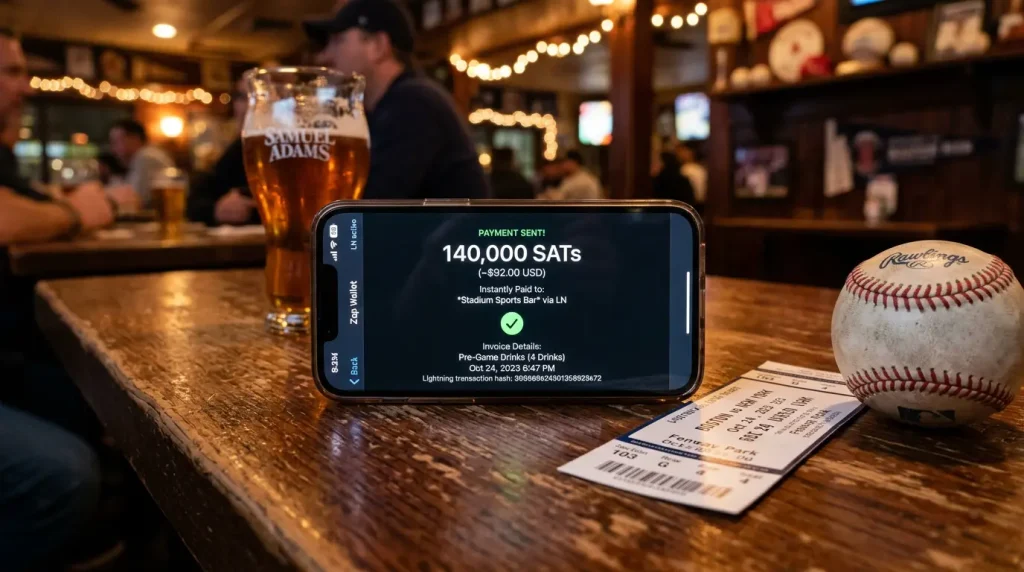
Instant Bitcoin Withdrawals and Channel Limits Explained
I had a moneyline ticket cash on a Yankees game in the late innings. I tapped withdraw on the sportsbook, picked Lightning, scanned an invoice from my mobile wallet, and watched the funds appear in my wallet before the post-game show had finished its second commercial break. Total elapsed time, from “withdraw” to “funds available”, under thirty seconds. The same withdrawal in standard Bitcoin would have taken thirty to ninety minutes to clear three confirmations; in Tron USDT around two; in ERC-20 USDT five to ten depending on gas. Lightning is in a different time class.
For a UK bettor who places multiple wagers across an evening of MLB, the practical case for Lightning is not philosophical. It is operational. The faster you can move funds in and out of a sportsbook, the more flexibly you can size positions, the more easily you can defend against drawdowns, and the less of your bankroll sits exposed to operator risk overnight. Bitcoin still represents around seventy-seven per cent of all crypto sportsbook handle and the segment processed roughly fourteen billion dollars of bets in 2025; Lightning is the layer that makes that BTC dominance practical for an active live-betting workflow. This piece explains how it works, who supports it, and what the trade-offs actually are.
The mechanics, without the cryptography
Lightning is a payment layer that sits on top of Bitcoin. The core idea is that two parties open a payment channel by locking some Bitcoin into a multi-signature on-chain transaction, then exchange unlimited off-chain payments between themselves by updating the balance of that channel. When either party closes the channel, the final balance settles to the Bitcoin blockchain in a single on-chain transaction. The on-chain operations – open and close – are slow and carry a fee. The off-chain operations between are functionally instant and carry a fee measured in satoshis, often less than a penny.
You do not need a direct channel to every counterparty. Lightning routes payments across the network, hopping through nodes that have inbound and outbound channel capacity in the right places. The result is that a payment from your wallet can reach a sportsbook node in a fraction of a second, with the routing fees subtracted from the amount along the way. The sender pays a small bounty to each hop; the total cost is typically under ten satoshis on a payment of any reasonable size.
The two practical concepts to understand are channel capacity and inbound liquidity. Channel capacity is the maximum size of a payment that can pass through a given channel. If your wallet has a channel with a hundred-pound capacity and you try to pay a hundred and twenty pounds, the payment fails and the wallet looks for an alternative route. Inbound liquidity is your ability to receive payments – you cannot receive more in a single payment than the inbound capacity available in your channels.
Which crypto sportsbooks actually support Lightning
The list of crypto sportsbooks that support Lightning is shorter than the marketing suggests. The pattern across the larger global operators is that Lightning is offered for withdrawal but not for deposit. The reason is risk management. Deposits via Lightning would require the operator to accept payments without the same level of address-history visibility that on-chain Bitcoin provides; withdrawals are easier because the operator is initiating the payment to a customer-supplied invoice. Some operators offer Lightning for both directions but with low caps on Lightning deposits.
The smaller crypto books often do not offer Lightning at all, sticking to the standard Bitcoin chain, ERC-20, and Tron USDT. The infrastructure cost of running a Lightning node with sufficient inbound and outbound liquidity, integrated into the operator’s withdrawal pipeline, is non-trivial, and operators below a certain handle threshold do not justify the investment.
If Lightning matters to you, the test before depositing is to look at the cashier panel for both deposit and withdrawal flows. If Lightning appears only on the withdrawal side, that is a sign of a serious operation that has weighed the trade-offs. If it appears for both, even better, with caveats around deposit caps. If it does not appear at all, you are likely at a smaller operator with less infrastructure investment, and the rest of the book’s quality signals are worth a closer look.
The flow that works for a UK bettor
The end-to-end flow I run looks like this. I hold working capital on a UK-registered centralised exchange – Coinbase, Kraken, or one of the equivalents that provides Lightning withdrawal as a feature. I withdraw via Lightning to a self-custody Lightning wallet on my phone – Wallet of Satoshi, Phoenix, or Muun, depending on which I am rotating through that month. From the self-custody wallet, I send Lightning payments to the sportsbook’s withdrawal address or an invoice the sportsbook generates on demand.
For deposits where the sportsbook does not offer Lightning, I either send standard BTC from the centralised exchange or I convert a slice of holdings to Tron USDT first. For withdrawals, I almost always pick Lightning if it is available. The funds are in a self-custody wallet within a minute, can be aggregated into a larger Lightning balance, and converted back to GBP via the exchange’s Lightning deposit feature within the same evening if I want to off-ramp.
The operational benefit is twofold. First, the withdrawal is fast enough that I am not running an exposed sportsbook balance overnight. Second, the privacy profile of a Lightning payment is structurally different from an on-chain payment. The Lightning network does not expose individual hop balances to the public ledger, which means an external observer who is monitoring my on-chain Bitcoin wallet cannot see the Lightning transactions to or from the sportsbook unless they also control the relevant nodes.
Limits, edge cases, and where Lightning breaks down
Lightning is not a tool for large transfers in a single hit. Channel capacities on the public network are mostly in the low millions of satoshis – equivalent to several hundred pounds in 2026 prices – and routing reliability degrades as the payment size approaches the smallest channel capacity in the chosen route. A payment of a few thousand pounds in a single Lightning transaction will sometimes succeed and sometimes fail with a routing error, depending on the network state at that moment.
The workaround is multi-part payments – splitting a single notional payment across multiple parallel routes – but not every wallet and not every sportsbook supports them cleanly. For withdrawals at the upper end of the limit, the failure case is annoying but recoverable: the wallet will refund the partial payments and the sportsbook can re-issue the withdrawal using the standard Bitcoin chain. For mid-sized routine withdrawals, Lightning works.
The other edge case is wallet liquidity rebalancing. A self-custody Lightning wallet that runs low on inbound liquidity cannot receive further payments until rebalancing happens. Most consumer wallets handle this automatically, with occasional friction. If you rely on Lightning for the bulk of your inflows, keeping enough headroom is something to monitor rather than ignore.
One macro point worth knowing: across all UK gambling operators, ninety-six and a third per cent of withdrawals are processed automatically and only a tenth of one per cent take longer than forty-eight hours. That is the fiat benchmark. A well-run crypto operator on Lightning beats those averages on speed of credit, but does not always beat the bottom-of-distribution worst case, because internal review on a flagged Lightning withdrawal can still hold the funds for AML checks regardless of the underlying rail.
Choosing the rail for deposits and withdrawals is one part of the broader operational picture – for the full picture of how funds move into and out of a crypto baseball sportsbook from the UK, see my walkthrough of crypto sportsbook deposits and withdrawals for baseball.
Articles


Published by the BlockPlate team.
