
Betting MLB with Stablecoins vs Bitcoin
 Available in US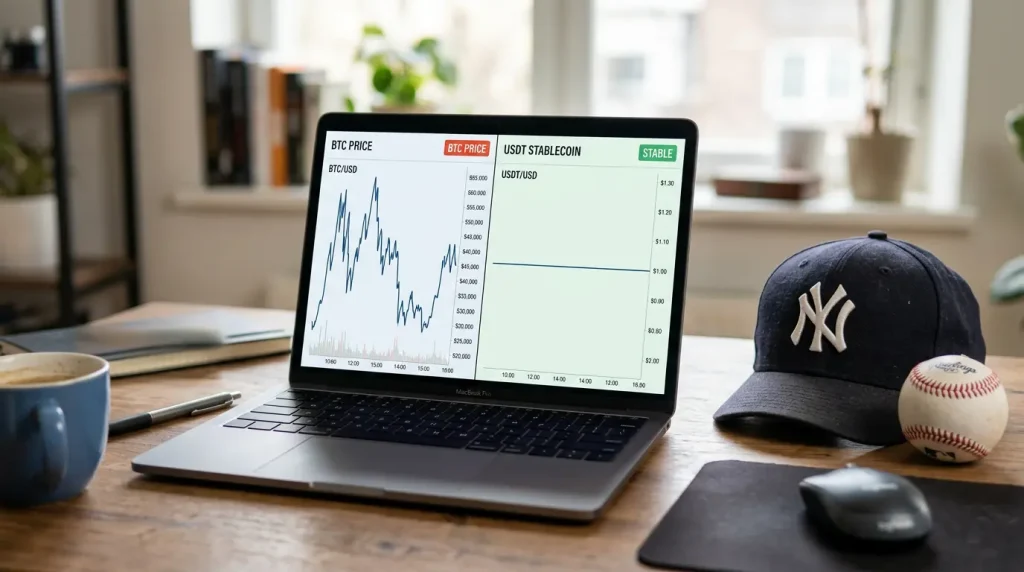
Balancing Volatility and Transaction Limits at Bookmakers
A friend of mine put roughly five hundred pounds onto a crypto sportsbook in BTC last summer. He went on a decent run on MLB run lines through July and August and finished the run with what he thought was eight hundred pounds equivalent. Then he opened the cashier on a quiet Sunday and discovered that BTC had drifted down twelve per cent over the holding period. His sport return was real – the run lines won – but the GBP value of his account at the moment he tried to off-ramp was barely above his original stake. He had been winning at baseball and losing at currency at the same time.
The decision a crypto MLB bettor faces every time they fund a sportsbook is therefore not “which coin among many” but rather “do I want exposure to the underlying asset, or do I want pure exposure to the sport”. For most UK bettors who have arrived at crypto sportsbooks through a baseball interest rather than a Bitcoin interest, the answer to that second framing is “I want pure sport exposure”. The right tool for that is a stablecoin. The right tool for “I am comfortable with BTC exposure as an asset” is BTC. The wrong tool is to treat them as interchangeable because they are both labelled “crypto” on the cashier dropdown.
What volatility actually costs over a holding period
Bitcoin moves. The smoothed annualised volatility of BTC has been somewhere between fifty and seventy per cent across the last five years, which translates to a daily standard deviation of around three to four per cent. On a three-hour MLB game window, the realised price move is small in expectation – a fraction of a per cent – but the tails are fat. A wager placed on a Wednesday afternoon and settled on a Friday night spans most of two trading sessions, two news cycles and two opportunities for a macro headline to move the underlying.
For a single moneyline ticket in the standard nine-inning window, the FX cost is essentially noise relative to the sports decision. The price might move one per cent in either direction; on a hundred-pound stake that is one pound of variance against a sports bet that is itself fluctuating by significantly more.
The economics flip on longer-dated positions. A futures bet held for six months sees BTC’s distribution open up. Over a six-month window, a BTC position has historically had a standard deviation of around twenty per cent. That is not a tail event. That is the typical experience. Twenty per cent of variance on a futures bet that is itself paying eight to one is enough to swallow the sport return in either direction. The same logic, less dramatic, applies to a series-betting ticket held over a five or seven-day postseason window.
The effect compounds when you are running a sustained schedule. Wagering BTC across a season means every win and every loss is being booked against a moving denominator. Even if your sport ROI is positive, your GBP ROI can be flat or negative if BTC drifted down across the season. The mismatch is not theoretical – it is what most casual crypto bettors actually experience.
Stablecoins solve volatility, but bring a different problem
USDT and USDC pin the value of your sportsbook balance to the dollar. A bet placed in USDT for a hundred dollars on Wednesday afternoon and settled at one hundred and ninety on Friday night returns one hundred and ninety dollars. The sport result is the entire move. There is no FX overlay.
The trade-off is the AML profile. Stablecoins are by some measures the dominant rail for illegal cryptocurrency flows. Across 2024, sixty-three per cent of all illegal crypto transactions identified happened in stablecoins, with the total illegal crypto volume estimated at forty billion dollars. The AML systems run by sportsbooks, and by the centralised exchanges that bettors use to off-ramp back to GBP, are tuned to that environment. Large stablecoin movements attract heightened scrutiny. A withdrawal of five thousand dollars in USDT will, at most operators, trigger source-of-funds review more reliably than a five-thousand-dollar BTC withdrawal of equivalent value.
The peg-risk angle is real but small. USDT and USDC have both broken peg in stress events – single-digit percentage drops that lasted hours, not days – and have re-stabilised. If your strategy involves holding stablecoin balances at a sportsbook for weeks, peg-stress events are a non-zero risk. For a bettor who deposits, plays through the slate, and withdraws within a few days, peg risk is functionally zero.
One operational note about the difference between USDT and USDC. USDC has historically been positioned as the more compliance-friendly of the two – its issuer publishes monthly attestations and operates under a US regulatory framework that USDT does not match. For a UK bettor, that distinction occasionally matters at the off-ramp: some UK exchanges support USDC more readily than USDT for inbound transfers. For deposit and play within a sportsbook, both work; for the round trip back to GBP, USDC has slightly less friction at most UK exchanges I have used.
The other side of the trade
Bitcoin sits at around seventy-seven per cent of all crypto sportsbook handle. That market share matters because it translates to deeper liquidity, better limits, and stronger promotional support on most operators. A wager in BTC at a high-handle book often clears at a higher single-bet limit than the equivalent stablecoin wager. Welcome bonuses are sometimes priced in BTC and convert to stablecoin equivalents at less generous internal rates. Cash-out offers on live wagers are sometimes faster on BTC than on stablecoin because the operator’s risk model is tuned to its dominant rail.
For a bettor who is comfortable with BTC as an asset and wants the operational benefits of betting on the operator’s preferred currency, BTC is the cleaner choice. For a bettor who is purely sport-focused and wants to neutralise the underlying-asset bet, the stablecoin path is the cleaner one – at the cost of slightly more friction and slightly more KYC attention.
I have run both. My pragmatic split is straightforward: anything settled within a single calendar day, BTC. Anything held overnight or longer, stablecoin. Futures, no exception, stablecoin. Series-betting tickets in the postseason, stablecoin. The daily slate of moneyline plays, BTC. That split has been working for me over the last several seasons and the GBP-denominated ROI of my account ledger reflects sport performance more cleanly than it did when I was running everything in BTC.
The pragmatic decision tree
The fastest way to make this decision is to ask three questions in order. How long will the position be open? If under twenty-four hours, the FX cost is small enough that BTC is fine. If overnight to a few days, the stablecoin route reduces variance meaningfully. If a futures ticket held for weeks or months, stablecoin is essentially mandatory unless you specifically want the BTC bet.
How large is the wager relative to your bankroll? A single large position on a futures ticket should be in stablecoin regardless of duration, because the FX overlay can swing the result independent of the sport. A small ticket can be in either, with the operational case for BTC slightly stronger if your operator has BTC-only promotional offers.
How often will you be off-ramping to GBP? A bettor who off-ramps weekly and can absorb FX risk in small bites is fine in BTC. A bettor who lets balances accumulate before a single large off-ramp should hold those balances in stablecoin to avoid the build-up of FX exposure.
The choice between Bitcoin and stablecoins is one slice of the larger question of which coin to use; the full comparison across BTC, ETH, USDT, USDC, LTC and Tron-based options is in the best cryptocurrency for MLB betting.
Articles



Written by the editors at BlockPlate.
