
On-Chain MLB Decentralised Prediction Markets
 Available in US
AMM Mechanics and Oracle Settlements for UK Traders
The first time I traded an MLB outcome on a decentralised prediction market, I was not entirely sure what I had just done. I had not placed a bet with a sportsbook in any conventional sense. I had bought a token whose price would settle at one dollar if the Yankees won and zero if they did not, on a peer-to-peer order book that lived on a public blockchain. The counterparty was another anonymous wallet that had taken the other side. There was no operator in the middle setting a line. There was no hold built into the spread other than the slight bid-offer the market itself had produced. The transaction settled when the underlying smart contract was triggered by the published result and the winning tokens redeemed for the underlying stablecoin.
This is genuinely a different product from a sportsbook wager. The legal question of whether it is gambling, in which jurisdiction, and under whose rules, is unsettled enough that any UK bettor encountering these markets should approach with care. The crypto gambling segment is large – around eighty-one billion dollars in 2025 by the available industry figures – and prediction markets are a small but growing slice of that aggregate. This piece walks through the mechanics, the practical experience for a UK user, and the regulatory considerations that matter.
How a decentralised prediction market actually works
Every market is a smart contract that defines an outcome and a resolution mechanism. For an MLB market, the contract specifies the game, the winning condition, and the data source that will settle the outcome. Users buy “yes” tokens and “no” tokens at prices determined by the order book or the automated market maker, with each pair summing to one unit of the underlying collateral – typically a stablecoin like USDC. Buying yes at fifty-five cents means risking fifty-five cents to receive one dollar if the outcome resolves yes; the seller of that yes token is taking the no side at forty-five cents.
The resolution mechanism is the part that distinguishes one prediction market protocol from another. The two dominant approaches are oracle-based and committee-based. Oracle-based protocols pull the official MLB result from a designated data feed and settle automatically at the published score. Committee-based protocols submit the resolution to a governance vote – token holders or appointed validators decide the outcome based on evidence – with dispute mechanisms layered on top. For a settled-score MLB market the oracle approach is simpler and faster; for ambiguous markets – “will this player win the MVP” before voting concludes – the committee approach is better suited.
Liquidity at most prediction markets is a fraction of what a major crypto sportsbook offers. The headline volumes on Polymarket and similar venues are dominated by political and macroeconomic markets; sports markets are present but generally thinner. Limits on individual bets are correspondingly lower. A wager of a few hundred pounds equivalent on an MLB moneyline market on a major prediction market venue is fillable; a wager of several thousand pounds on the same line will move the market against you measurably as you fill it.
The pricing mechanism is interesting because it differs from a sportsbook. There is no operator with a deliberate hold. The bid-offer spread is whatever the market participants produce. On thin markets, the spread can be wide – five or ten cents on a one-dollar contract – which is functionally equivalent to a high hold. On liquid markets, the spread compresses to a fraction of a cent, which is significantly tighter than any sportsbook hold. The variability is the key feature: prediction market pricing is not uniform across the slate the way a sportsbook’s pricing is.
Why MLB markets are interesting on this venue
The first reason is the absence of a built-in hold. An MLB moneyline at a sportsbook with a five per cent hold is a bet at minus-1.05 effective. The same line at a thick prediction market with a half-cent spread is a bet at minus-1.005 effective. The difference compounds across volume. A bettor who places hundreds of wagers a season at the tighter pricing structure has a meaningful advantage on identical sport reads.
The second reason is access to markets a sportsbook will not post. Prediction markets allow user-created markets on outcomes the operator-curated sportsbook universe does not include. Specific innings outcomes, exotic prop combinations, conditional probabilities – these can be created by a user with the necessary collateral and resolved by the same oracle infrastructure that handles standard moneylines. The variety is wider than any sportsbook, even if the depth on any single market is thinner.
The third reason is the on-chain transparency of the trading record. Every transaction is publicly visible on the blockchain. The order book is published. The resolution data is auditable. The provably-fair claim that means little for sportsbook markets means quite a lot for prediction markets, because the entire mechanism is on-chain and verifiable. There is no operator running a black-box pricing engine.
The UK regulatory and access reality
The UK regulatory framework around decentralised prediction markets is in flux. The Cryptoassets Regulations under the Financial Services and Markets Act were adopted on the 4th of February 2026 and come into force on the 25th of October 2027. The regulations broaden the FCA’s regulatory perimeter for cryptoasset activities, with the explicit intention of bringing UK-related crypto activity under formal authorisation. The exact scope of how prediction markets fit into this framework is the subject of ongoing consultation, but the direction of travel is clearly toward more regulation, not less.
From a gambling perspective, the UK Gambling Commission’s position on offshore gambling activity by UK residents is straightforward. Operating gambling services to UK customers without UK licensing is unlawful from the operator’s side. Participating in such services from the customer side is not formally criminalised but does not benefit from the consumer protections that come with UK-licensed operators. Whether a decentralised prediction market is “gambling” in the UK regulatory sense depends on its specific structure, the nature of the contract, and how it is presented to UK users. Some prediction markets explicitly geofence the UK to avoid the question; others do not, leaving the user with the legal uncertainty.
The practical access route for UK users on the venues that do not block UK access is through a self-custody wallet – MetaMask, Rabby, or equivalent – funded with USDC from a UK exchange, connected to the prediction market’s frontend. The technical friction is non-trivial for a user new to DeFi, but is well-documented and comparable to the friction of any DeFi protocol. The compliance friction is more material: the source-of-funds and AML considerations that apply to any crypto withdrawal apply equally to funds entering or leaving prediction market positions.
One specific point about taxation. Prediction market wins that resolve to USDC are still capital gains under UK CGT rules at the moment of disposal, in exactly the same way as any other crypto asset. The “is this gambling” question is partly about whether the underlying activity is taxable as gambling – which would make it tax-free – or as trading and investment, which would make it taxable. The cautious position, until the regulatory picture clarifies, is to treat prediction market activity as taxable trading rather than tax-free gambling and report accordingly. This is the position my accountant has taken with my activity and is the safer reading until HMRC publishes specific guidance.
What the practical flow looks like for a UK user
The setup is a one-time effort and the ongoing flow is straightforward. Funds move from a UK CEX in stablecoin to a self-custody wallet, the wallet connects to the prediction market frontend, and trades execute by signing transactions in the wallet. Each trade is a regular blockchain transaction with the standard gas cost; on Polygon or other low-fee chains the gas is negligible, on Ethereum mainnet it is substantial. The settlement of winning positions happens automatically when the underlying smart contract resolves, with the redeemed stablecoin appearing in the same wallet.
The risk profile is genuinely different from a sportsbook. The custody risk is the user’s own – there is no operator that could freeze funds or refuse a withdrawal – but the smart contract risk is real. Bugs in prediction market protocols have produced real losses for participants in the past. The maturity of the established protocols has reduced this risk substantially, but it has not eliminated it. The practical mitigation is to use only well-established protocols with audited code and significant time in production, and to size positions appropriately for the residual risk.
The regulatory uncertainty around prediction markets sits inside the broader picture of UK crypto gambling regulation – FCA, UKGC and HMRC each have a piece of it, and the picture is changing. I have written that picture up in my walkthrough on UK crypto gambling regulation for baseball bettors.
Articles


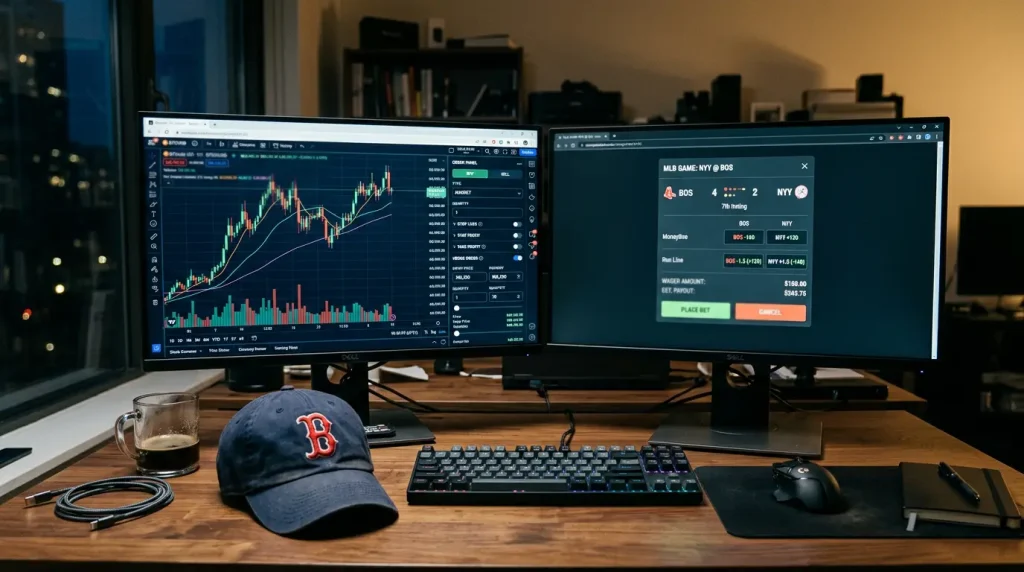

Created by the "BlockPlate" editorial team.
