
MLB MVP and Cy Young Futures at Crypto Bookmakers
 Available in US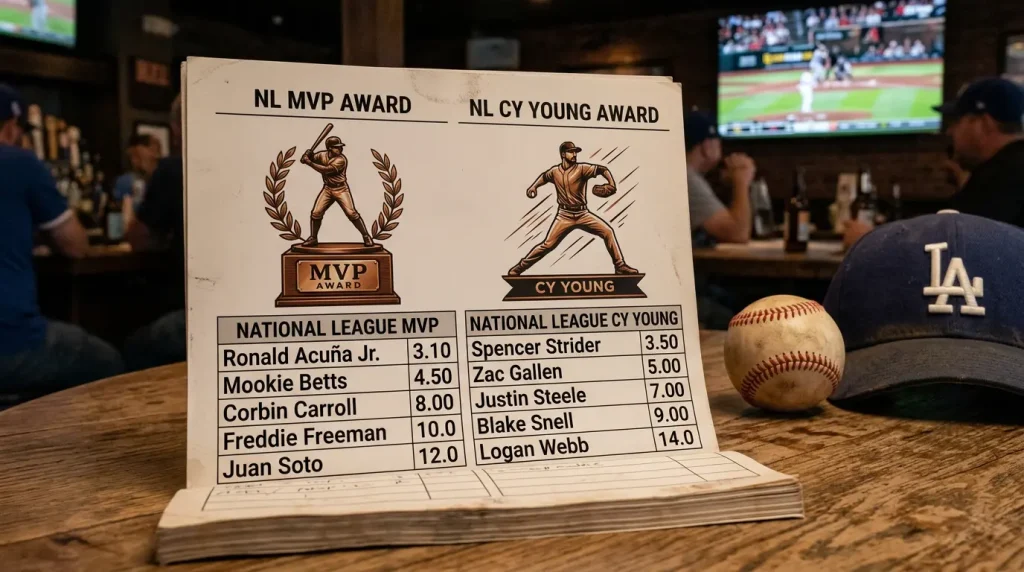
Modeling Award Voter Trends for Outright Sportsbook Value
The first MVP futures ticket I ever cashed was on a starting pitcher who never won the actual award. The reason it cashed: the operator’s settlement rule paid on the player who finished top-three in BBWAA voting, not strictly on the winner. The second MVP futures ticket I cashed was on an outfielder I had picked in March, watched stumble through July, and very nearly cashed out on in August before deciding to ride. It cashed because September was kind. The lesson, repeated across both: MVP and Cy Young futures are not pure sports markets. They are markets on what professional baseball writers will conclude after the season ends, which means the bet has two parts running in parallel – the player’s performance, and the sportswriters’ framing of that performance.
This piece is about how to think clearly about award futures, how the two parts interact, where the soft pricing tends to be, and how the typical crypto operator handles the market. The 2025 MLB regular season produced 71.4 million in attendance and was the most-watched in social-media terms with 17.8 billion views – the third year of attendance growth in a row. That growth has translated into wider futures coverage at crypto sportsbooks, which is the operational reason the awards markets are now reasonably tradable on the books I use.
The four awards and what they actually reward
American League MVP and National League MVP go to the most valuable player in each league as voted by a panel of two beat writers from each city in the league. The vote is announced after the regular season but before the World Series. There are also Cy Young, Rookie of the Year, and Manager of the Year awards in each league, voted by the same general panel structure. The total list of MLB end-of-season awards has six headline categories – two MVPs, two Cy Youngs, two Rookies of the Year, plus the Manager and Reliever-of-the-Year awards in each league – but for futures betting purposes the MVP and Cy Young markets carry far more handle than the others.
MVP voting historically rewards a combination of “best individual season” and “narrative weight”. A player on a contending team has a structural advantage over a player putting up identical numbers on a losing team. The narrative bias is well-documented and has narrowed somewhat since the BBWAA membership has skewed younger and more analytically minded, but it has not gone away. A player whose stat line is excellent and whose team is also in the playoff race is a stronger MVP candidate than the same stat line on a team out of contention by August.
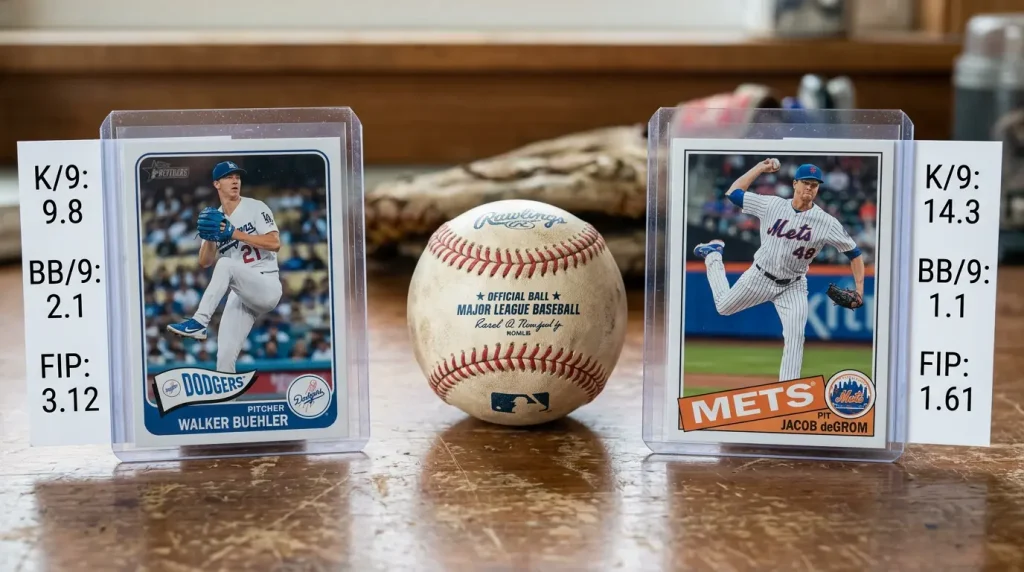
Cy Young voting is more analytical. ERA, strikeouts, innings pitched, and increasingly FIP and WAR are the metrics that drive votes. The narrative-on-team-quality element is weaker than for MVP. This makes Cy Young futures more amenable to a sports model: predict the pitcher most likely to lead the league in the relevant counting and rate stats, and you have a strong baseline forecast for the vote.
Rookie of the Year is usually a two-horse race in each league between the year’s most prominent debutants. Manager of the Year is a hard market to model because the criteria are vague and the voting is often a tribute to “exceeded expectations” rather than to absolute team quality. Both are markets I generally avoid for serious volume.
The modelling difference between MVP and Cy Young
For Cy Young, the projection problem is roughly the same as projecting any other counting-stat outcome. Take the season’s leading candidates – the top six or eight pitchers by current pace on FIP, ERA, strikeouts, innings – and weight by the probability each will continue at pace through season-end. Adjust for innings remaining and projected workload. The candidate with the highest combined projected stat profile, in proportion to playing time, is the model’s pick. Sample-size adjustments matter less than they did at midseason because the voters increasingly weight the full-season number.
For MVP the projection problem has a second layer on top. The same kind of stat-line projection produces the candidate set, but the weight on each candidate has to be adjusted for narrative variables. Is the candidate’s team in the postseason picture? If the answer flips from “yes” in August to “no” in September, the candidate’s MVP probability drops sharply regardless of stat performance. Is there a competing candidate whose team is in playoff contention while ours is not? The team-comparison effect lowers our candidate’s standing. Is there a “story” – a milestone, a return from injury, a record chase – that gives one candidate a public relations advantage? The story candidates are over-priced by the public and sometimes under-priced by sharp money in the early season; by the September narrative window they are usually over-priced by everyone.
The voter-bias adjustment is what makes MVP a harder market to model cleanly than Cy Young. The model can be correct on the player and wrong on the vote. Cloudbet covers more than forty sports and esports and the futures markets at the larger crypto operators have generally tightened over the past three years to reflect the analytical sophistication of the betting market – but voter bias remains a residual edge for a bettor who can read both the stat line and the story.
Where to find the markets and where to skip
The largest global crypto operators carry the full slate of MLB awards futures from spring training through to the post-season vote. Both MVPs, both Cy Youngs, both Rookies of the Year, both Managers of the Year, and sometimes the Reliever and Comeback awards. The hold across these markets is wide – typically twenty-five to thirty-five per cent – because the operator has many candidates to embed margin against and the public action concentrates on a handful of headline names.
Smaller crypto sportsbooks usually only post the top three or four candidates in each award market. The exclusion of long-shot candidates is the operator’s way of capping its exposure on a market it does not have the trading depth to price across the full field. The implication is that the long-shot candidate who might have been a value pick at decimal twenty or thirty at a larger operator is simply not available at the smaller one.
Live updates during the season vary significantly by operator. The largest books re-price futures intraday based on the previous night’s stat lines and the current standings, with new candidates added as they emerge. Mid-tier books update weekly. Smaller books update only when a major event – an injury, a trade, a manager change – forces a re-pricing.
The bankroll discipline a thirty per cent hold demands
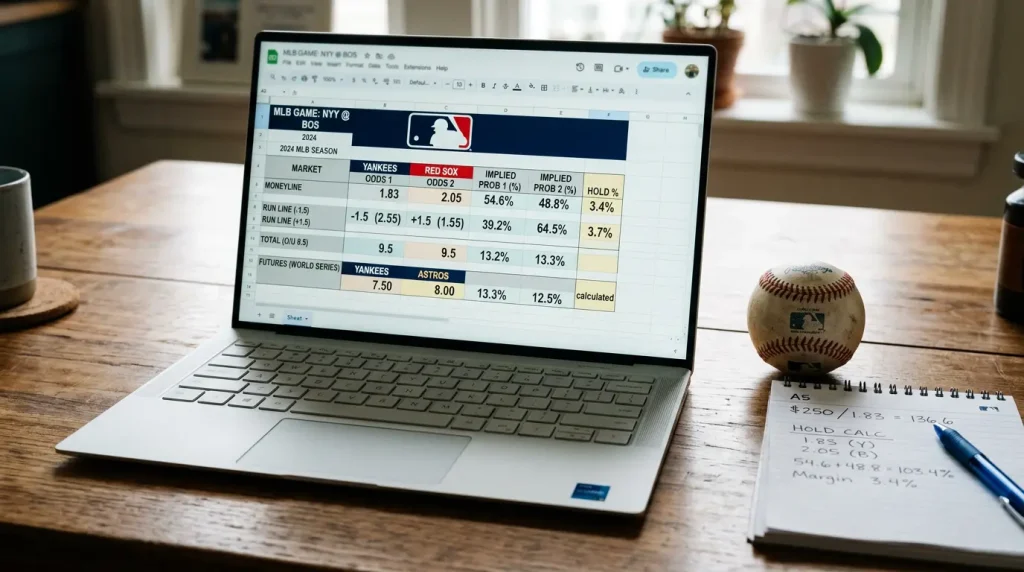
A market with a thirty per cent hold needs the bettor to have a substantial edge on the implied probability before the bet has positive expected value. A candidate priced at decimal ten – implied ten per cent – needs to be genuinely better than ten per cent likely to win to be a value pick, and after subtracting the hold, the actual fair-value probability needs to be closer to thirteen or fourteen per cent. That is a meaningful gap to find against a market that includes thirty experienced trading desks and a public actively pricing the market over months.
The 2025 MLB regular season’s growing attendance and viewership figures translate into more handle on award futures than the markets carried in 2020. More handle means tighter pricing on the headline candidates and slightly looser pricing on the long shots. The pattern I have observed is that the value, when it exists, is on candidates priced between decimal eight and decimal twenty – players the public has noticed but not consensus-anointed – rather than on the favourite at decimal three or the long shot at decimal one hundred.
I size MVP and Cy Young futures at half my standard MLB unit. The hold is high enough that even confident picks have only modest expected value, and the season-long holding period adds variance from injuries and slumps that has nothing to do with the original sport read. The position needs to be sized to absorb that variance without disproportionate drawdown.
Award futures sit alongside the other long-dated MLB markets – the same modelling and bankroll considerations apply with the World Series-specific twists I unpack in World Series futures betting with crypto.
Articles

Written by the editors at BlockPlate.
