
Calculating Sportsbook Vig on MLB Crypto Markets
 Available in US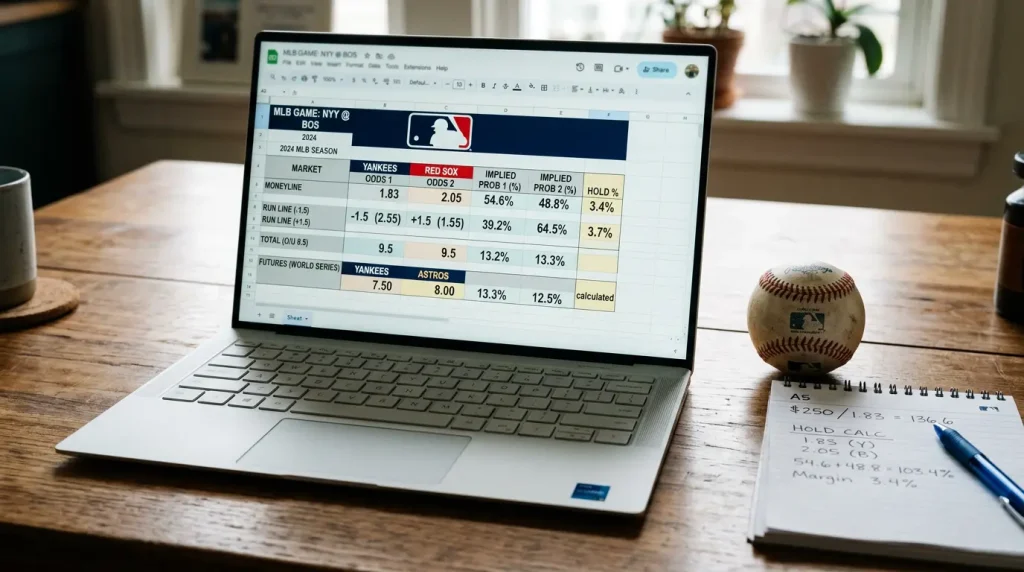
Identifying High Margins on Baseball Props and Futures
Most bettors track the wrong things. They track the bonus offered, they track the speed of withdrawals, they track the user interface. The single number that should sit at the centre of every operator comparison – the embedded margin the book takes out of every line – is the one almost nobody computes before they place. The bonus is finite. The interface is forgettable. The hold is on every wager you ever place at that operator, every day, in perpetuity. A book with a six per cent moneyline hold is structurally a different proposition from a book with a four per cent moneyline hold, and across a season of meaningful volume the difference between them is the difference between a profitable account and a losing one.
The Cloudbet spokesperson commenting on their 2026 data made a useful observation about the popularity of different sports on a crypto book – that nobody is surprised that basketball, soccer and tennis top the list, but the way they top it tells you something interesting about how crypto bettors actually behave, with soccer drawing more individual bets than any other sport while basketball ranks higher when measured by total money placed. The same logic applies to baseball markets. Different bet shapes attract different cohorts of bettor, and the operator’s hold on each shape reflects the cohort’s price-sensitivity. This piece is about how to compute the hold, what it looks like across different MLB markets, and how to use the number to compare books.
The maths is one line of arithmetic
For a two-sided market – moneyline, run line, total runs over/under, anything where the bet has exactly two outcomes – the hold is computed by taking the inverse of each side’s decimal price, summing the two inverses, and subtracting one. The result is the cumulative implied probability above one hundred per cent that the operator has built into the line.
Take a typical MLB moneyline. Favourite at decimal 1.65, underdog at decimal 2.40. Inverse of 1.65 is 0.606. Inverse of 2.40 is 0.417. Sum is 1.023. Subtract one. The hold is 2.3 per cent. That is unusually low and would only be seen on a sharp book on a high-volume game.
A more typical line: favourite at decimal 1.55, underdog at decimal 2.45. Inverse of 1.55 is 0.645. Inverse of 2.45 is 0.408. Sum is 1.053. Subtract one. The hold is 5.3 per cent. That is the average MLB moneyline hold across a competitive market. Anything materially above that is the operator pricing more conservatively than the market average; anything materially below is the operator pricing aggressively for handle.
For markets with more than two outcomes – three-way moneyline, futures across thirty teams, prop bets with multiple lines – the calculation is the same arithmetic. Sum the inverses across all options, subtract one. The result is the cumulative overround. The bigger the market, the more places the operator has to embed margin, and the larger the typical hold.
Hold by market type
Moneyline on MLB at the larger crypto operators sits around four to six per cent on a typical regular-season game and tightens to three to four per cent on high-volume marquee fixtures. The variation is across operators rather than across games at the same operator – a competitive book will sit at four to five per cent across most games, while a fattier book will sit at six to eight.
Run line on MLB is structurally similar to moneyline because the line is binary at the standard one-and-a-half. Holds run four to six per cent at typical operators. The exception is alternate run lines – plus or minus 2.5 or wider – which are thinner markets and carry holds two to three per cent above the standard line.
Total runs over/under sits at four to five per cent across the larger operators. The market is binary, the trader knows the distribution of outcomes well, and the hold reflects competitive pressure from sharp money on this market segment.
Player props move the hold up substantially. Hit-a-home-run, total bases, hits-plus-runs-plus-RBIs, strikeout props all carry holds in the seven to fifteen per cent range, with smaller crypto operators sometimes pushing higher. The reason is that prop markets are less liquid and the trader has more uncertainty about fair value. The bettor pays for the additional uncertainty.
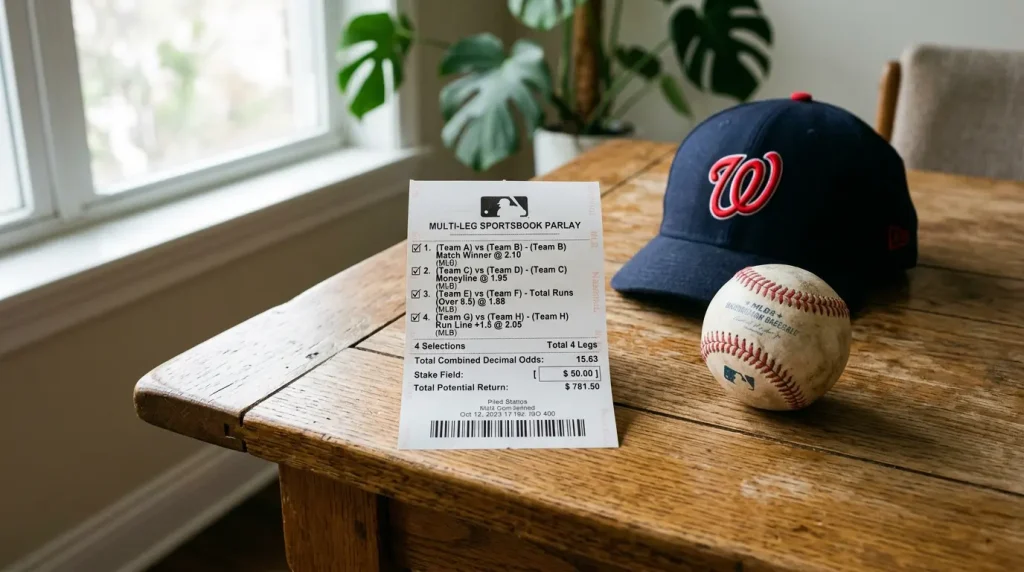
Same-game parlay tickets compound the hold across the legs. A two-leg SGP at six per cent per leg is roughly twelve per cent cumulative; a five-leg parlay at six per cent per leg is twenty-five per cent or more. The compounding is multiplicative, not additive, because each leg’s margin reduces the overall payout proportionally.
Season-long futures – World Series, MVP, Cy Young, division winners – are an entirely different category. The hold across all thirty teams in a futures market typically runs twenty-five to thirty-five per cent, and a few smaller crypto operators push above forty. The bettor takes a five to ten point margin penalty per ticket compared to the standard match-day markets. Stake.com clears around one and a tenth billion dollars in monthly deposit volume and operates with a market share above fifty per cent among the largest crypto casinos, which gives it the operational scale to price futures more competitively than smaller operators – but even at that scale, futures hold is structurally above match-day hold.
Crypto vs fiat: the marketing claim and the reality
The claim some crypto operators make is that they offer “sharper prices” than fiat books because their cost structure is lower. The argument runs that without payment processing fees and without the infrastructure burden of fiat banking, the operator can pass the savings to the bettor through tighter holds. The argument is half right. The cost structure is genuinely lower at a well-run crypto operator. The savings are partially passed through. They are not entirely passed through, and the gap between fiat and crypto hold is smaller than the marketing suggests.
In practice, the largest global crypto operators run holds on MLB moneyline that are within a percentage point or two of the largest fiat operators on the same markets. The crypto-side advantage is more visible on niche markets – KBO, NPB, MLB props on lower-profile games – where the global trading desk has built up an edge that smaller fiat operators have not invested in matching. On core moneyline at marquee fixtures, the markets converge.
The smaller crypto operators are a different story. Books with thin trading desks and limited liquidity sit at moneyline holds of seven to ten per cent or more, and at futures holds of forty per cent or more. The headline bonus offers at these operators are sometimes generous, but the hold structure means the bettor pays back the bonus value across a small number of standard wagers. Computing the hold before placing is the only way to spot this; the bonus alone tells you nothing about the underlying economics.
The bottom line, on every line
The shortest possible discipline rule: before placing any wager, compute the hold on the market you are betting into. Decimal odds, summed inverses, subtract one. If the hold is above six per cent on a moneyline, ask whether the same bet is available somewhere with a tighter hold. If the hold is above eight on a run line, the same. The wager is not a bad wager because the hold is high; it is just a more expensive version of the bet, and the bettor’s edge needs to overcome the higher embedded margin to produce the same expected value.
The other application is comparison across operators. A book that consistently sits at lower holds across all market types is structurally a better venue for sustained volume than one that sits higher, regardless of bonus structure or interface quality. A bettor who plays at three operators across a season, whose holds are 4.5 per cent, 5.5 per cent and 7.5 per cent on moneyline, is paying meaningfully different rents at each, and the cumulative effect over hundreds of wagers is large.
Holds compound across multi-leg slips and the maths gets dramatic quickly – for the parlay-specific arithmetic and how to read accumulator boost promotions against it, see my piece on baseball accumulators at crypto sportsbooks for UK players.
Articles


Prepared by the BlockPlate editorial staff.
