
Live In-Play MLB Betting with Crypto
 Available in US
Managing Latency and Line Refresh Speeds for Live Bets
The first time I tried to live-bet an MLB game on a crypto sportsbook, I clicked “place” on a half-inning total over and the bet rejected because the line had moved between the moment I tapped and the moment the request reached the operator’s trader. I tapped again. Rejected again. By the third try the inning was over and the line had vanished. Live MLB betting is a different sport from pre-game wagering. The decision window is shorter, the line is moving on signals you can see and signals you cannot, and the sportsbook’s infrastructure stack matters as much as your model.
What changed live betting on baseball more than any rule of the last twenty years is the pitch clock. The 2025 MLB regular season averaged a game time of two hours thirty-eight minutes – the third consecutive season under the two-and-three-quarter-hour mark for the first time in the modern era – and the broader trend has filled stadiums in a way that took everybody by surprise. The same regular season produced 71.4 million in attendance, the third year of growth in a row. Faster games and bigger crowds. The market for live MLB wagering has scaled up alongside both, and crypto sportsbooks have invested heavily in the in-play product to capture the demand.
This piece is about how live MLB betting actually works on a crypto book – what markets are on offer, how fast the line moves, what your latency budget realistically is, and where the edge tends to hide.
If you need to move funds quickly to catch a live line, utilizing the Lightning Network for instant payouts is an absolute game-changer.
What you can wager during a game
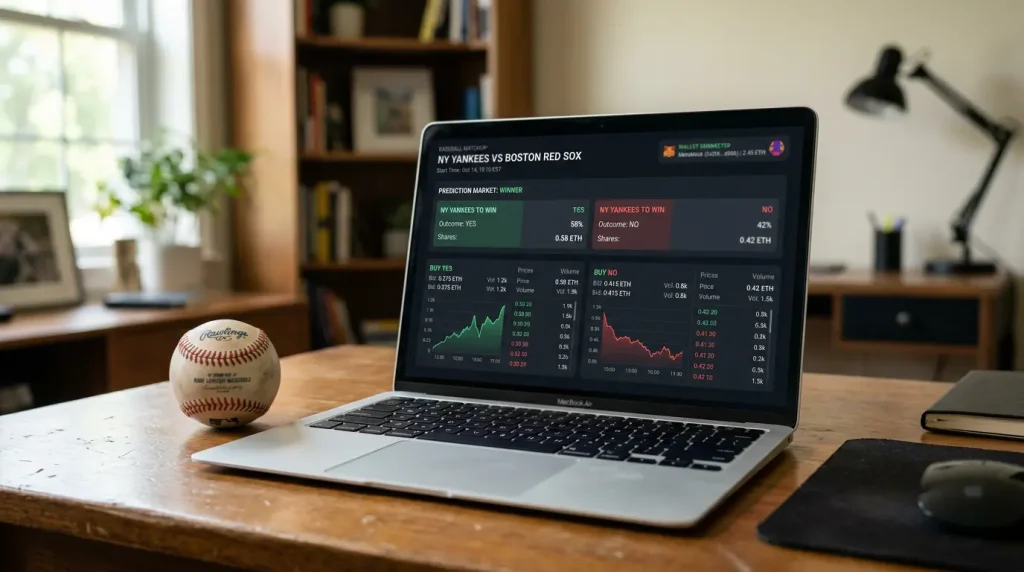
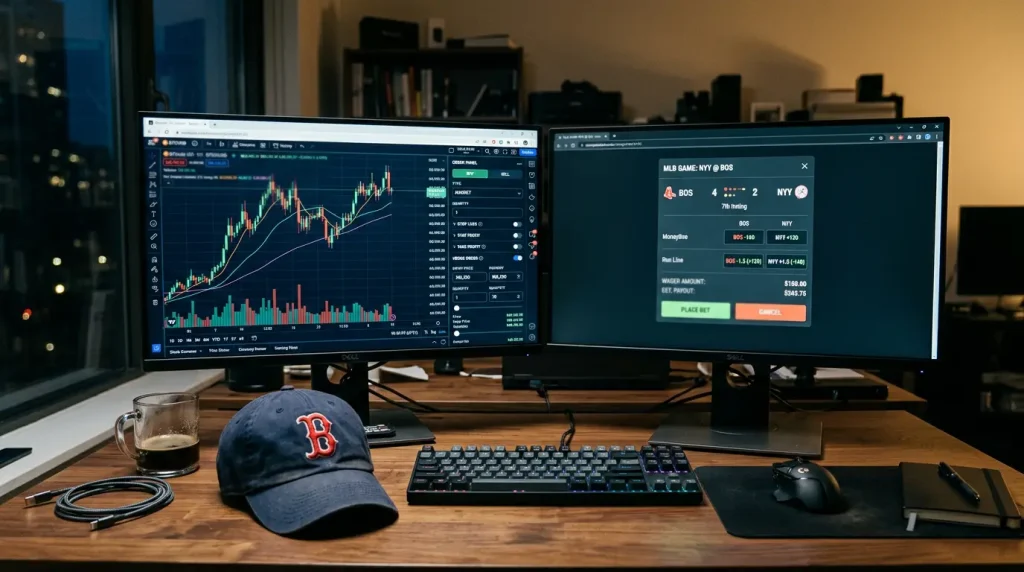
The standard live menu on a competent crypto sportsbook covers half-inning markets – over/under runs in the next half-inning, will the next half-inning produce a run yes or no, leading team after this half-inning – plus a continuously updated moneyline, a continuously updated total runs over/under, and continuously updated alternate run lines. Some of the larger global crypto books also offer next-pitch outcome markets – strike, ball, in play, hit by pitch – which are essentially micro-derivatives of the at-bat. Pitch-by-pitch markets are not universal; smaller crypto operators do not bother because the trader effort to price them in real time is significant.
Half-inning markets are the bread and butter of live baseball wagering. They are short-cycle, well-defined, and the variables driving the price are limited enough that you can build a real-time mental model: pitcher remaining innings, bullpen state, top-of-order vs bottom-of-order, score state. A grid of half-inning runs over/unders for the next two innings, evaluated quickly, is where I spend most of my live attention.
Live moneyline drift is the slower-moving market. It updates after every plate appearance, sometimes within an at-bat. The price reflects scoreboard state, base-runner state, who is at the plate, who is on deck, and the implied win probability calculation that the operator’s model spits out. The drift is rarely a value opportunity at the larger books – the model is sharp – but at smaller books the line lags more visibly and that lag can be the edge.
Same-game parlays in live mode are increasingly common at the bigger crypto operators and almost completely absent at smaller ones. They give you the option to combine a half-inning total with a player prop or a moneyline shift, which is a tool I use sparingly because the correlation handling at most operators is approximate at best.
How fast the line actually moves
Between batters, the line is closed for a few seconds while the trader’s model digests the change in base state, score state, and pitch count. The line then reopens with a new price. During an at-bat, the line is usually frozen entirely. After a substitution – pitcher change, defensive replacement – the line freezes for longer because the trader has to repaint the model with the new pitcher’s metrics or the new fielder’s defensive grade.
The faster the operator’s data feed, the shorter these freeze windows. Cloudbet’s 2026 numbers indicated coverage of more than forty sports and esports with serious year-on-year volume growth in baseball alongside basketball, tennis and football, and that volume is the sort of operational scale that justifies investment in real-time data pipelines. The gap between an operator running its own pitch-by-pitch feed and an operator pulling delayed data from a third-party aggregator is, in practical terms, the difference between a live market that is bettable and one that is not.
If you want to know whether an operator is in the first camp or the second, the test is simple: watch the line during a high-leverage at-bat in the late innings. A book on a real-time feed will close the line as the pitch is delivered and reopen it with new pricing within seconds of contact. A book on a delayed feed will sometimes still show the pre-pitch line a full ball and strike behind the actual game, which is an arbitrage opportunity in theory and an account-flagging risk in practice.
Stay updated with the latest in-play strategies and platform reviews at BlockPlate.
Settlement, and why “instant” is misleading
Live wagers settle at the conclusion of the half-inning or the conclusion of the game, depending on the market. A half-inning runs over/under settles the moment the third out is recorded in that half. A live moneyline settles at the final out of the game. A live runs total at the final out of the game.
The “instant settlement” claim that some crypto operators make refers to the on-chain payout speed once the bet has cleared internally, not to the speed of internal settlement. There is always an internal review window – typically a few seconds for routine wagers, longer for high-stakes or unusual ones – between the official end of the relevant period and the credit appearing in your wallet. The blockchain finality, when it lands, is fast; the internal step is unavoidably present.
Voids on suspended games follow the same logic as pre-game markets. If the game is suspended before official length, all live wagers void. If the game is official and ends early, settlements take effect on the score at the moment of stoppage, with the same operator-specific exceptions worth checking on the rules tab.
Latency, network choice, and which coin to keep on the slip
If you live-bet at any volume, the practical question is not which coin gives you the best moneyline price – it is which coin lets you reload your sportsbook balance fast enough to keep wagering. Standard Bitcoin on-chain confirmations take ten minutes per block and the operator typically waits for one to three confirmations before crediting. That is the wrong tool for a thirty-minute window of live wagering.
Lightning Network deposits clear in seconds. Tron USDT clears in a couple of minutes at minimal cost. Either is a far better fit for an active live-betting session than the standard BTC chain. I keep a working float in Lightning or Tron USDT during a live session and reload from a centralised exchange in those rails specifically for the speed.
The other latency consideration is the network between you and the sportsbook. A patchy mobile signal during a live session is the difference between hitting a price and missing it. If I am live-betting an evening MLB game from home, I am doing it on the home connection, not on the train. The bet rejection I described in the opening of this piece happened on a train, and I have not made that mistake since.
The pitch clock is the single biggest reason live MLB betting in 2026 looks different from live MLB betting in 2022 – for the full picture of how that rule reshaped pacing, totals and prop pricing, see my piece on how the MLB pitch clock changed crypto baseball betting.
Articles


Prepared by the BlockPlate editorial staff.
