
Bankroll management for crypto MLB betting from the UK
 Available in US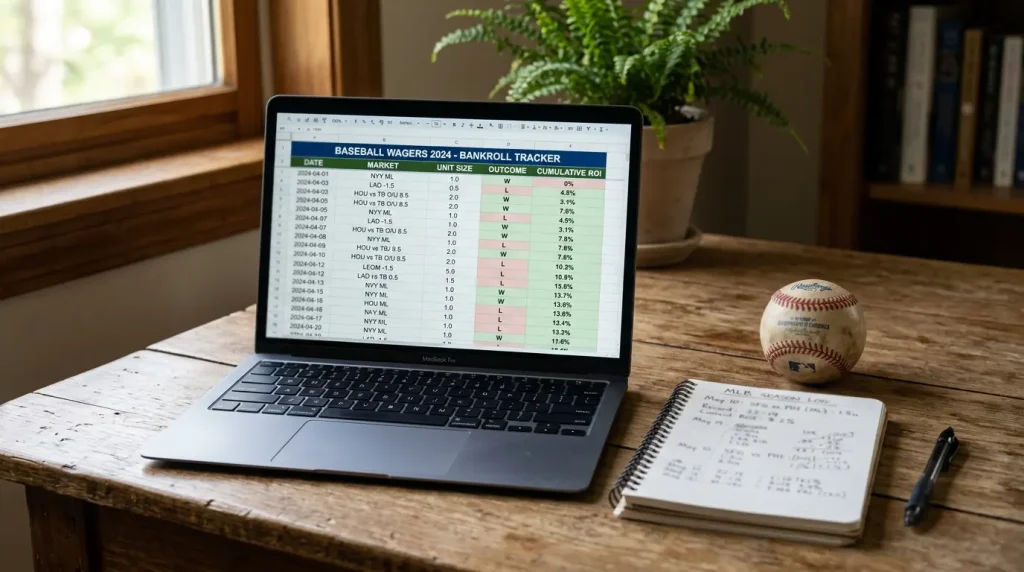
The discipline that beats a sharper model
Two bettors. One has a moderately sound MLB model and rigorous bankroll discipline. The other has a sharper model and bets without size discipline. Across a long-enough sample, the second bettor goes broke; the first finishes the season ahead. I have watched this play out on the major sportsbook forums over and over. The maths is unsentimental: a strategy with a positive expected return per unit of stake will still bankrupt the bettor if the unit size is large enough relative to the bankroll for the ordinary variance of the strategy to push through zero. Discipline is not the topping on the model. Discipline is what keeps the model alive long enough for the edge to manifest.
The crypto layer adds a second dimension to the problem because the bankroll itself is denominated in a currency that moves. A two per cent unit on a one BTC bankroll, with BTC sitting at a moving GBP price, is a different operational stake from week to week even when the BTC unit count is constant. UKGC research has found that crypto traders score higher on PGSI than non-crypto traders – a measurable elevation in problem-gambling indicators in the same demographic – and the broader UK regulatory environment around online gambling is shifting in response. The Chancellor has framed online gaming as resulting in more serious harms relative to less harmful land-based forms, with policy moving accordingly. None of this changes the maths of bankroll discipline; it does sharpen the importance of it.
The staking models, ranked by how well they actually work
Flat staking is the simplest. Every wager is the same notional size – typically one to two per cent of the current bankroll, recalibrated periodically. The benefit is operational simplicity and emotional steadiness; the drawback is that it does not size up on high-conviction reads or down on low-conviction reads. For most bettors, the simplicity is worth more than the marginal optimisation. Flat staking is what I default to when my read confidence is uniformly distributed across my bet shapes.
Percentage staking – Kelly criterion in its various forms – is the analytical alternative. Kelly sizes each wager according to the bettor’s edge over the operator’s price, with the formula stake = (edge / odds) × bankroll producing the wager that maximises long-term geometric growth. Full Kelly is mathematically optimal but emotionally brutal because the variance of full-Kelly bankroll is enormous. Half-Kelly and quarter-Kelly are the practical alternatives – sized at half or a quarter of the formula’s prescription – which trade some growth rate for substantially lower variance. Quarter-Kelly is what I run when I have a high-confidence read on a specific wager.
Confidence-tiered flat staking is the middle path. Wagers are categorised into tiers – typically three: standard, conviction, and high-conviction – with each tier sized at a fixed percentage. Standard at one per cent, conviction at one and a half, high-conviction at two. The tier assignments come from the model’s edge calculation but are quantised rather than continuous, which avoids the over-precision of Kelly without sacrificing the directional benefit of varying size with confidence. This is what most successful sustained bettors I know actually run.
Martingale and other progression systems – doubling after losses, increasing after wins – are mathematically guaranteed to bankrupt the bettor across a long-enough sample. They do not work. The fact that they are still being marketed and that newer bettors still try them is one of the more consistent failure patterns in the segment.
The currency question: BTC bankroll versus stablecoin bankroll
The choice of bankroll currency is a structural decision that affects everything downstream. A bankroll in BTC is exposed to BTC’s underlying price movement, which means the bankroll size in GBP terms changes with BTC’s price independently of the bettor’s wagering performance. A bettor running a sound MLB strategy in BTC can finish the season with positive sport ROI and negative GBP ROI if BTC drifted down across the season – and the reverse. The currency overlay is a separate bet running in parallel.
A bankroll in stablecoin neutralises the currency overlay. The bankroll’s GBP value tracks the stablecoin’s peg, which is essentially flat. The bettor’s GBP-denominated performance reflects sport performance, full stop. The trade-off is that some operator promotional offers, some bonus structures, and some welcome offers are priced in BTC and convert to stablecoin equivalents at less generous rates. The aggregate friction is small but real.
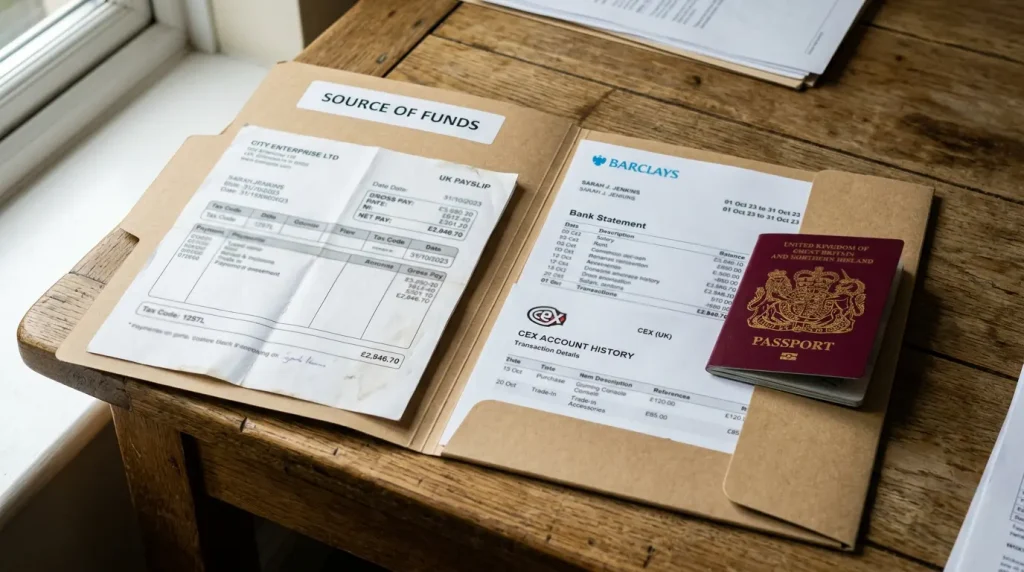
The empirical illegal-flow data – sixty-three per cent of all illegal cryptocurrency volume in 2024 happened in stablecoins – is the explanation for why stablecoin operations sometimes attract more AML scrutiny than equivalent BTC operations. For a clean UK bettor, this manifests as slightly more documentation requests on stablecoin-denominated activity than on BTC-denominated activity at the same notional sizes. The friction is real but is not, by itself, a reason to choose BTC over stablecoin if the underlying asset risk argues for stablecoin.
My pragmatic split is to run a bankroll in stablecoin for any sustained MLB activity, and to use BTC for short-duration plays where the currency overlay is small relative to the sport stake and where the operator’s BTC-side promotional offers are materially better. The stablecoin bankroll absorbs the season-long volume; BTC supplements with specific tactical positions.
Responsible discipline, beyond the staking maths
The UKGC’s pilot programme on financial vulnerability checks – examining whether high-spending players show patterns of distress – found that high-spend players were two to five times more likely to default on financial obligations compared to general loan applicants. The data is sobering. The pattern that produces these defaults is not that high-spending bettors are uniformly losing; many are not. The pattern is that the spend itself, regardless of net win or loss, has crowded out the financial buffers that would otherwise absorb life events. A bettor who wins on net but has wagered more than their financial situation can absorb in a stress scenario is in a more precarious place than a casual bettor who loses small.
The disciplines that matter beyond the staking model. First, define the bankroll separately from any other money. The bankroll is the amount at risk; nothing outside the bankroll is allowed to be added to it without a deliberate decision and a recalibration. Second, define a stop-loss at the bankroll level. If the bankroll declines by twenty per cent, pause and review the strategy before continuing. If it declines by forty per cent, withdraw entirely and reset. Third, define a session-level discipline – number of bets per day, hours of play, screen time – that prevents the betting from expanding into time the bettor needs for other things. Fourth, set the deposit and time limits within the operator’s responsible-gambling tools at conservative levels and review them quarterly.
None of these is glamorous. None of them is part of the model. All of them are what separate the bettor who is still around five seasons later from the bettor who quietly disappeared.
Record-keeping that supports both performance review and self-assessment
The minimum record set per wager: date and time, sportsbook, market, line taken, decimal price, stake in operator currency, GBP equivalent at the moment of placement, settlement result, return in operator currency, GBP equivalent at the moment of settlement. This is the same data that supports both performance review – am I actually positive expected value across my volume – and the UK CGT self-assessment record at year end.
The two practical formats are spreadsheet and software. Spreadsheet works for a bettor with modest volume and a single operator. Once volume crosses several hundred wagers a year or more than one operator is involved, dedicated tracking tools become more reliable. The performance review benefits from being able to slice the data – by sportsbook, by market type, by month, by line size – and a structured tool handles this faster than a spreadsheet does.
The CGT angle is that the same record set supports the disposal calculations that feed self-assessment. Each crypto disposal – including swaps and the GBP off-ramp at the end – needs a documented date and GBP value. The bankroll-tracking spreadsheet that records GBP equivalents at placement and settlement is, with light cleanup, the source data for the self-assessment crypto schedule. The discipline of recording GBP equivalents in real time, rather than reconstructing them at year end, is the difference between a fifteen-minute year-end summary and a multi-day reconstruction.
Bankroll currency interacts directly with how to manage volatility on open positions – the holding-period FX exposure on a futures ticket, the hedging logic, the trade-offs between BTC and stablecoin denomination – and the operational mechanics of all of that are in my piece on hedging crypto volatility on open baseball bets.
Articles


Created by the "BlockPlate" editorial team.
